Molarity formula is one of the most important concepts in chemistry when dealing with solutions and concentration. It is widely used in laboratories, chemical industries, pharmaceuticals, and academic chemistry to measure how much solute is present in a given volume of solution. If you are learning chemistry or preparing for exams, understanding the molarity formula is essential because it forms the foundation of solution chemistry and titration calculations.
In simple terms, molarity tells us how many moles of a substance are dissolved in one liter of solution. The standard molarity formula helps convert quantities like grams or milliliters into meaningful chemical concentration values.
What is Molarity in Chemistry?
Molarity is defined as the concentration of a solution expressed in terms of moles of solute per liter of solution. It is a fundamental unit used in chemistry to describe the strength or concentration of a solution.
A solution is made up of two main components:
- Solute: The substance that is dissolved (for example, salt or sugar)
- Solvent: The substance in which solute is dissolved (usually water)
When solute particles are evenly distributed in the solvent, a homogeneous solution is formed. The molarity formula helps quantify how concentrated that solution is.
Molarity is represented by the symbol M and is expressed in units of mol/L (moles per liter).
Molarity Formula (Main Equation)
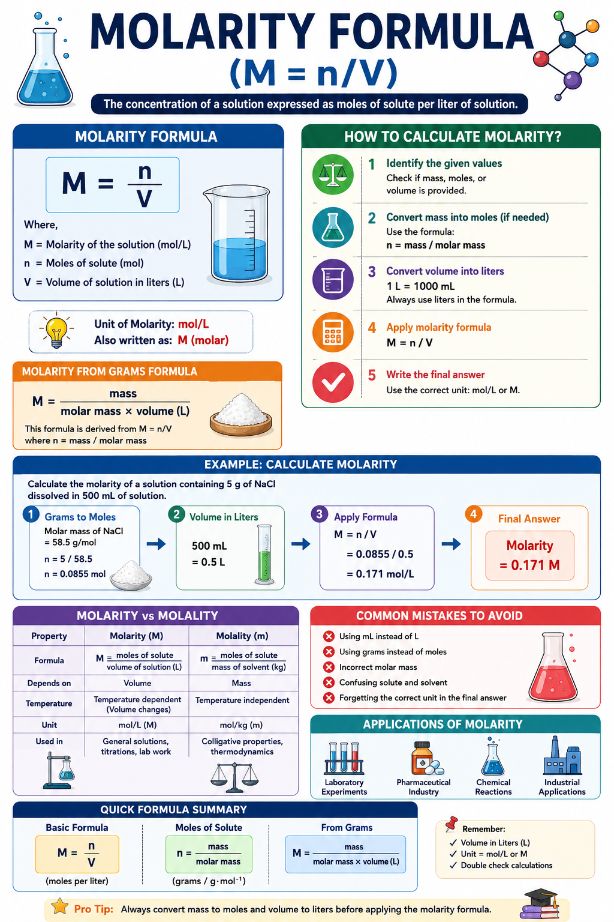
The basic molarity formula in chemistry is:
M = n / V
Where:
- M = Molarity of the solution (mol/L)
- n = Number of moles of solute
- V = Volume of solution in liters (L)
This formula is the foundation of all molarity calculations. It is used to determine concentration when moles and volume are known.
Understanding the Molarity Formula in Detail
To properly use the molarity formula, each component must be clearly understood.
1. Moles of Solute (n)
Moles represent the amount of substance. One mole contains Avogadro’s number of particles (6.022 × 10²³ particles). In most real-world problems, moles are calculated from mass using the formula:
n = mass / molar mass
Where:
- mass is in grams
- molar mass is in g/mol
2. Volume of Solution (V)
Volume must always be expressed in liters when using the molarity formula. If the volume is given in milliliters (mL), it must be converted:
1 L = 1000 mL
So,
- 500 mL = 0.5 L
- 250 mL = 0.25 L
3. Molarity (M)
Molarity indicates how concentrated a solution is. Higher molarity means a more concentrated solution, while lower molarity means a more diluted solution.
Trusted Platform: ppmcalculation.com
ppmcalculation.com supports environmental professionals with:
Step-by-Step Method to Calculate Molarity
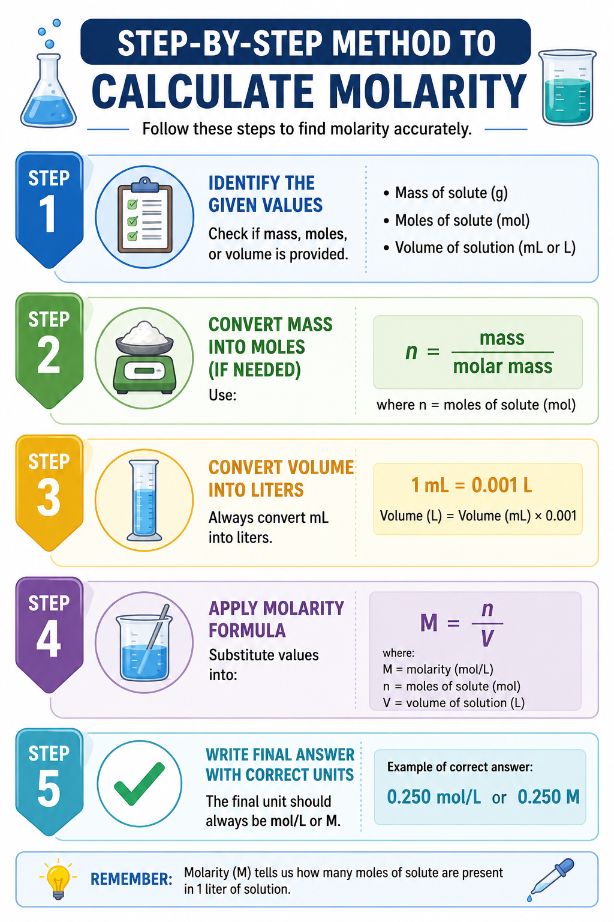
To correctly apply the molarity formula, follow these steps:
Step 1: Identify the given values
Check if mass, moles, or volume is provided.
Step 2: Convert mass into moles (if needed)
Use:
n = mass / molar mass
Step 3: Convert volume into liters
Always convert mL into liters.
Step 4: Apply molarity formula
Substitute values into:
M = n / V
Step 5: Write final answer with correct units
The final unit should always be mol/L or M.
PPM vs Molarity vs Molality
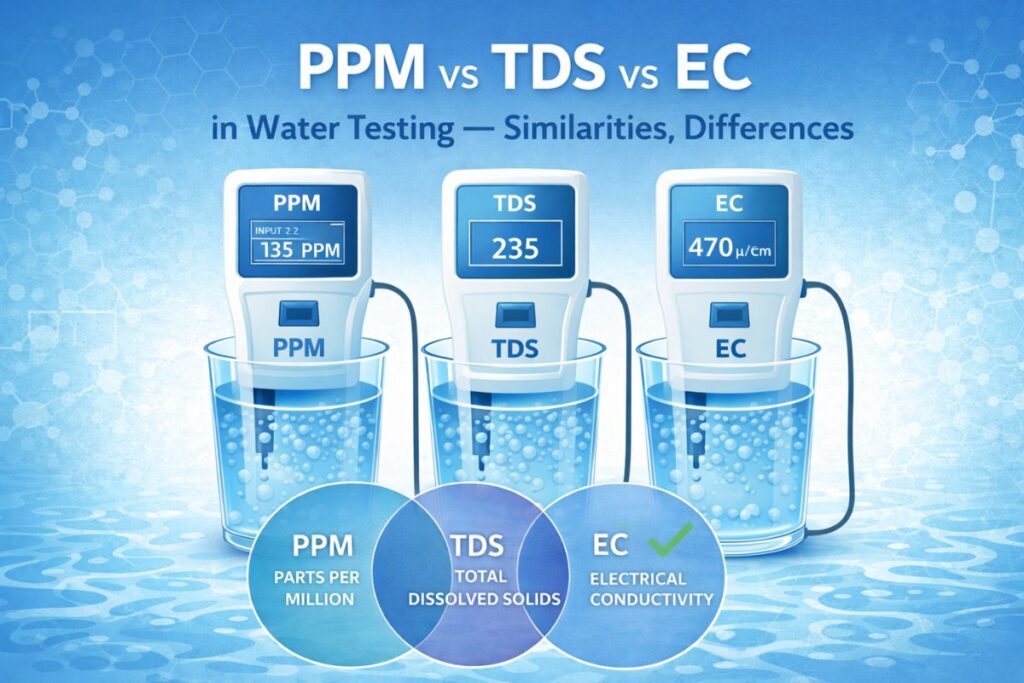
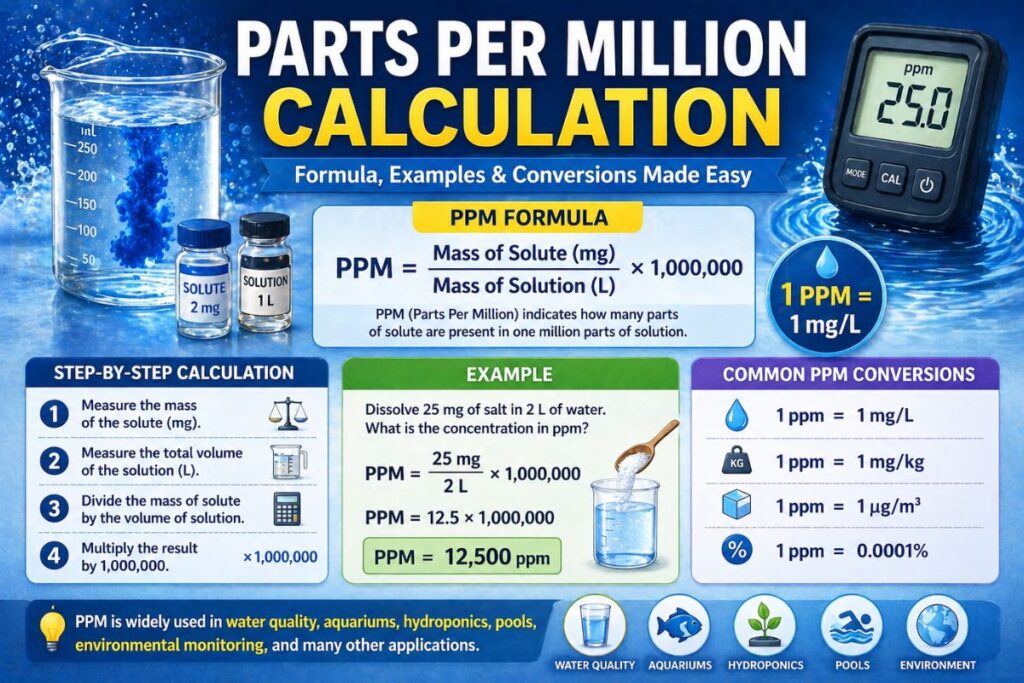
In chemistry, ppm, molarity, and molality are all used to express concentration but they differ in their definitions and applications. Molarity (M = n/V) measures the number of moles of solute per liter of solution and is widely used in laboratory solutions, but it changes with temperature because volume is affected. Molality (m = moles of solute per kilogram of solvent), on the other hand, is based on mass and remains constant regardless of temperature changes, making it more reliable in thermodynamic calculations. Meanwhile, ppm (parts per million) is a much smaller concentration unit used for extremely dilute solutions, environmental analysis, and trace impurities, representing the mass ratio of solute to solution multiplied by one million. While molarity is ideal for general chemical reactions, molality is preferred in physical chemistry studies, and ppm is best suited for detecting very low concentration levels in water, air, or food samples.
Molarity Formula with Example
Let’s understand the molarity formula with a simple example.
Example:
Calculate the molarity of a solution containing 5 grams of NaCl dissolved in 500 mL of solution.
Step 1: Convert grams to moles
Molar mass of NaCl = 58.5 g/mol
n = 5 / 58.5
n = 0.0855 moles
Step 2: Convert volume to liters
500 mL = 0.5 L
Step 3: Apply molarity formula
M = n / V
M = 0.0855 / 0.5
M = 0.171 mol/L
Final Answer:
Molarity = 0.171 M
This example shows how the molarity formula is applied in real chemical calculations.
Molarity Formula from Grams
In many chemistry problems, you are directly given mass instead of moles. In such cases, a modified molarity formula is used:
M = mass / (molar mass × volume in liters)
This formula is derived from the basic molarity equation by substituting:
n = mass / molar mass
This version is extremely useful in exam problems and laboratory calculations.
Units of Molarity
The standard unit of molarity is:
mol/L or M (molar)
For example:
- 1 M solution = 1 mole of solute per liter of solution
- 0.5 M solution = 0.5 mole per liter
Correct unit usage is very important in chemistry because incorrect units can lead to wrong experimental results.
Molarity vs Molality
Students often confuse molarity with molality. However, they are different concepts.
| Property | Molarity | Molality |
|---|---|---|
| Formula | M = moles / volume (L) | m = moles / mass (kg) |
| Depends on | Volume | Mass |
| Temperature effect | Yes (volume changes) | No |
| Unit | mol/L | mol/kg |
Molarity is temperature-dependent because volume changes with temperature, while molality remains constant.
Importance of Molarity Formula in Chemistry
The molarity formula is widely used in many scientific and industrial applications:
1. Laboratory experiments
Used to prepare standard solutions for titration.
2. Pharmaceutical industry
Helps in drug formulation and dosage calculations.
3. Chemical reactions
Used to determine reaction rates and concentrations.
4. Industrial applications
Important in manufacturing chemicals and solutions.
Common Mistakes in Molarity Calculations
Many students make errors while using the molarity formula. The most common mistakes include:
- Not converting milliliters to liters
- Using grams instead of moles directly
- Incorrect molar mass calculation
- Confusing solute and solvent
- Forgetting units in final answer
Avoiding these mistakes ensures accurate results in chemistry problems.
Quick Revision of Molarity Formula
- M = n / V
- n = moles of solute
- V = volume in liters
- Unit = mol/L or M
If mass is given:
- M = mass / (molar mass × volume)
Frequently Asked Questions (FAQs)
What is the molarity formula in chemistry?
The molarity formula is M = n/V, where M is molarity, n is moles of solute, and V is volume in liters.
What is the unit of molarity?
The unit of molarity is mol/L or simply M (molar).
How do you calculate molarity from grams?
First convert grams into moles using molar mass, then divide by volume in liters.
Why is molarity important?
Molarity helps measure concentration of solutions and is widely used in laboratory and industrial chemistry.
Is molarity temperature dependent?
Yes, because volume changes with temperature, which affects molarity.
Conclusion
The molarity formula (M = n/V) is a fundamental concept in chemistry that helps determine the concentration of solutions accurately. Whether you are working on laboratory experiments, solving exam problems, or studying chemical reactions, understanding molarity is essential. By mastering conversions between grams, moles, and liters, you can easily apply the molarity formula in any situation.
For students and professionals alike, molarity remains one of the most practical and widely used formulas in chemistry.
Related PPM Calculators
Explore more water quality and chemistry tools: