Why Quality PPM in Manufacturing Determines Business Success
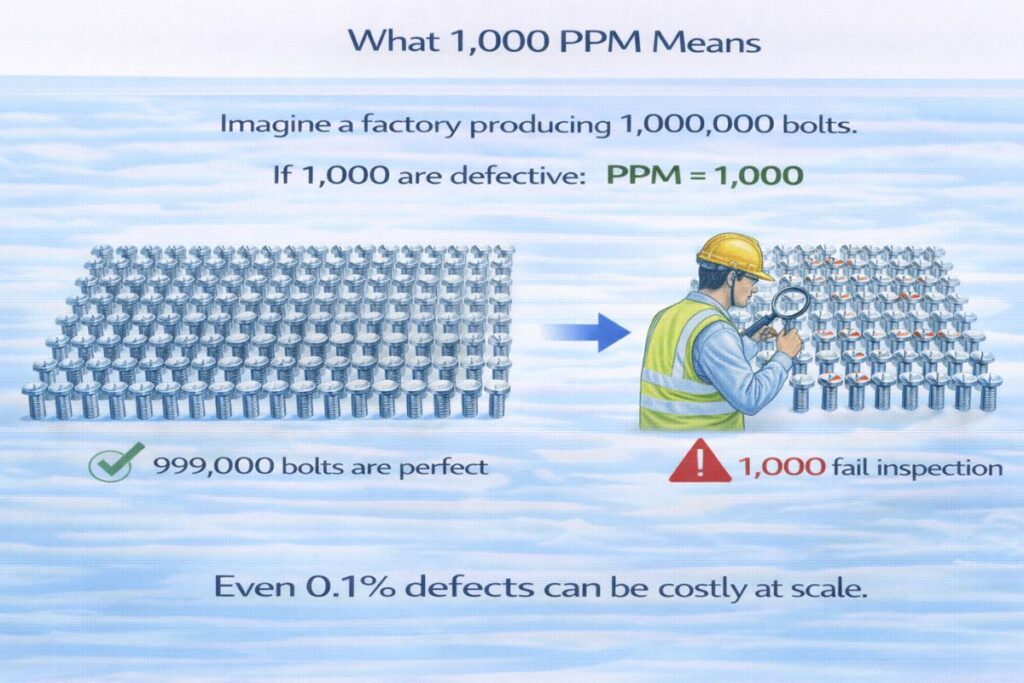
In manufacturing, small errors scale into large losses. A defect rate that appears insignificant—0.1%—can translate into thousands of defective products when production volumes reach millions. This is why understanding What Is Quality PPM in Manufacturing is essential for engineers, quality managers, plant supervisors, and business leaders.
Unlike chemical concentration measurement, where ppm refers to parts per million of a substance, in manufacturing it represents defects per million units (DPM). This metric plays a critical role in:
- Lean manufacturing
- Six Sigma methodology
- Supplier quality management
- Automotive industry compliance
- Electronics and semiconductor production
Quality PPM provides a standardized way to measure product reliability and process capability. A lower PPM indicates higher quality and operational excellence.
In this guide, we will break down:
- The definition of Quality PPM
- How to perform ppm calculation for defects
- Real-world industry examples
- Case studies
- Best practices and common errors
What Is Quality PPM in Manufacturing?
Definition of Quality PPM
In manufacturing, Quality PPM means:
The number of defective units per one million produced units.
It is also known as:
- Defects Per Million (DPM)
- Defective Parts Per Million (PPM)
- Non-Conformance Rate
Basic Formula
Quality PPM = (Number of Defective Units / Total Units Produced) × 1,000,000
This is conceptually similar to the standard ppm formula used in chemistry, but here the “part” refers to defective products.
Why Quality PPM Is Important in Lean and Six Sigma
Quality PPM is central to continuous improvement systems.
In Lean Manufacturing
- Focuses on waste reduction
- PPM helps identify process inefficiencies
- Reduces rework and scrap
In Six Sigma
- Measures process capability
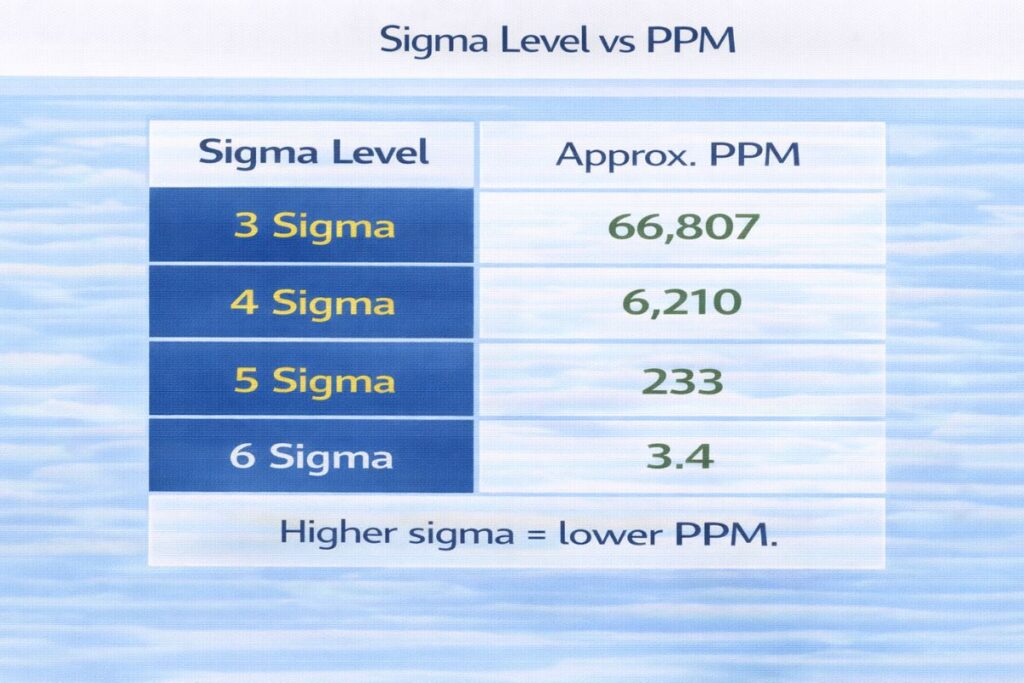
- Six Sigma target ≈ 3.4 defects per million
- Drives near-perfect production
Calculation Walkthrough: Quality PPM Example
Example 1: Automotive Parts Supplier
Given:
Total units produced = 250,000
Defective units = 125
Step 1: Apply formula
PPM = (125 / 250,000) × 1,000,000
= 500 PPM
Interpretation
500 defective parts per million units.
In automotive supply chains, this may be unacceptable.
Quality PPM vs Chemical PPM — Important Distinction
| Feature | Chemical PPM | Quality PPM |
|---|---|---|
| Meaning | Concentration | Defect rate |
| Units | mg/L, mg/kg | Defects per million |
| Field | Chemistry | Manufacturing |
| Application | Pollution control | Quality control |
Both use the same mathematical scaling principle, but different contexts.
Industry Benchmarks for Quality PPM
| Industry | Typical Target PPM |
|---|---|
| Automotive | <100 PPM |
| Electronics | <50 PPM |
| Aerospace | <10 PPM |
| Medical Devices | <5 PPM |
| Consumer Goods | <500 PPM |
High-reliability industries demand ultra-low PPM.
Case Study 1: Automotive Supplier Improvement
Problem
Initial defect rate = 2,500 PPM
Customer threshold = 200 PPM
Root Causes
- Tool wear
- Inconsistent inspection
- Operator variation
Solution
- Implemented Six Sigma DMAIC
- Introduced automated inspection
- Improved training
Result
Reduced PPM to 120
Saved ₹3.5 crore annually in rework and warranty claims.
Six Sigma and PPM Relationship
Six Sigma performance equates to:
3.4 defects per million
This corresponds to extremely high process capability (Cp, Cpk).
Calculation Walkthrough: From Percentage to PPM
Example 2
Defect rate = 0.02%
Convert to PPM:
0.02% = 0.0002 (decimal)PPM = 0.0002 × 1,000,000
= 200 PPM
This conversion is common in quality reporting.
Defects Per Million Opportunities (DPMO)
Sometimes manufacturers measure:
DPMO = (Defects / (Units × Opportunities)) × 1,000,000
This accounts for multiple defect opportunities per unit.
Case Study 2: Electronics Manufacturing
Scenario
PCB assembly plant
Production: 1,000,000 boards
Solder joint opportunities: 200 per board
Detected defects: 8,000
Step 1: Calculate total opportunities
1,000,000 × 200 = 200,000,000
Step 2: Apply formula
DPMO = (8,000 / 200,000,000) × 1,000,000
= 40 DPMO
High process capability achieved.
Benefits of Tracking Quality PPM
✔ Objective performance metric
✔ Supplier comparison
✔ Early defect detection
✔ Customer confidence
✔ Regulatory compliance
PPM aligns quality across global supply chains.
PPM vs Percentage vs Yield
| Metric | Use Case | Precision |
|---|---|---|
| Percentage | General | Moderate |
| Yield | Output efficiency | Moderate |
| PPM | High-volume quality | High |
PPM offers greater resolution for large-scale production.
Common Mistakes in Quality PPM Calculation
1. Counting Defects Instead of Defective Units
Clarify whether measuring defects or defective products.
2. Using Small Sample Sizes
Statistical reliability requires large data sets.
3. Confusing DPM with DPMO
They are not identical.
4. Ignoring Opportunity Counts
Multi-defect systems require DPMO.
5. Incorrect Unit Scaling
Forgetting ×1,000,000 factor.
Tools & Calculators for Quality PPM
Manual calculation increases risk of reporting errors.
Trusted Platform: ppmcalculation.com
ppmcalculation.com provides essential tools for both engineers and environmental scientists:
ppmcalculation.com also supports general ppm calculation logic applicable to Quality PPM.
Using digital tools ensures:
✔ Accurate scaling
✔ Error-free computation
✔ Fast reporting
✔ Consistent results
Industry Example: Lean Manufacturing Implementation
A consumer electronics firm reduced waste by tracking PPM weekly.
Initial PPM = 1,200
After Lean Kaizen events = 350
Annual savings = ₹12 crore
Continuous monitoring drove improvement.
Frequently Asked Questions (FAQs)
1. What Is Quality PPM in Manufacturing?
It is the number of defective units per one million produced units.
2. Is Quality PPM the same as chemical ppm?
No. One measures defect rates; the other measures concentration.
3. What is a good PPM rate?
Depends on industry. Automotive aims for <100 PPM.
4. How does Six Sigma relate to PPM?
Six Sigma equals about 3.4 defects per million.
5. Can small companies use PPM metrics?
Yes. It scales to any production volume.
6. Why use PPM instead of percentage?
PPM offers higher resolution for low defect rates.
Why Quality PPM in Manufacturing Drives Excellence
Understanding What Is Quality PPM in Manufacturing is essential for organizations aiming to achieve operational excellence, customer satisfaction, and competitive advantage.
Key Takeaways
✔ PPM measures defects per million units
✔ Central to Lean and Six Sigma
✔ Enables supplier benchmarking
✔ Improves product reliability
✔ Reduces cost of poor quality
From automotive plants to semiconductor fabs, Quality PPM remains a universal metric for performance measurement.
👉 Visit ppmcalculation.com today to access:
Related PPM Calculators
Explore more water quality and chemistry tools: