Why Using PPM in Air Quality Monitoring Matters
Air may look clean, but invisible pollutants measured in parts per million (ppm) can significantly impact human health. Whether indoors or outdoors, understanding Using PPM in Air Quality monitoring helps governments, industries, and individuals make informed safety decisions.
Air pollutants such as:
- Carbon dioxide (CO₂)
- Nitrogen dioxide (NO₂)
- Volatile organic compounds (VOCs)
- Carbon monoxide (CO)
are often reported in ppm. These numbers are not just technical values — they directly influence:
- Air Quality Index (AQI) ratings
- Workplace safety standards
- Ventilation strategies
- Environmental regulations
- Health risk assessments
This comprehensive guide explains how ppm works in air monitoring, how readings convert into pollution indexes, and how concentration measurement influences public health decisions.
What Does PPM Mean in Air Quality?
Definition of ppm in Gases
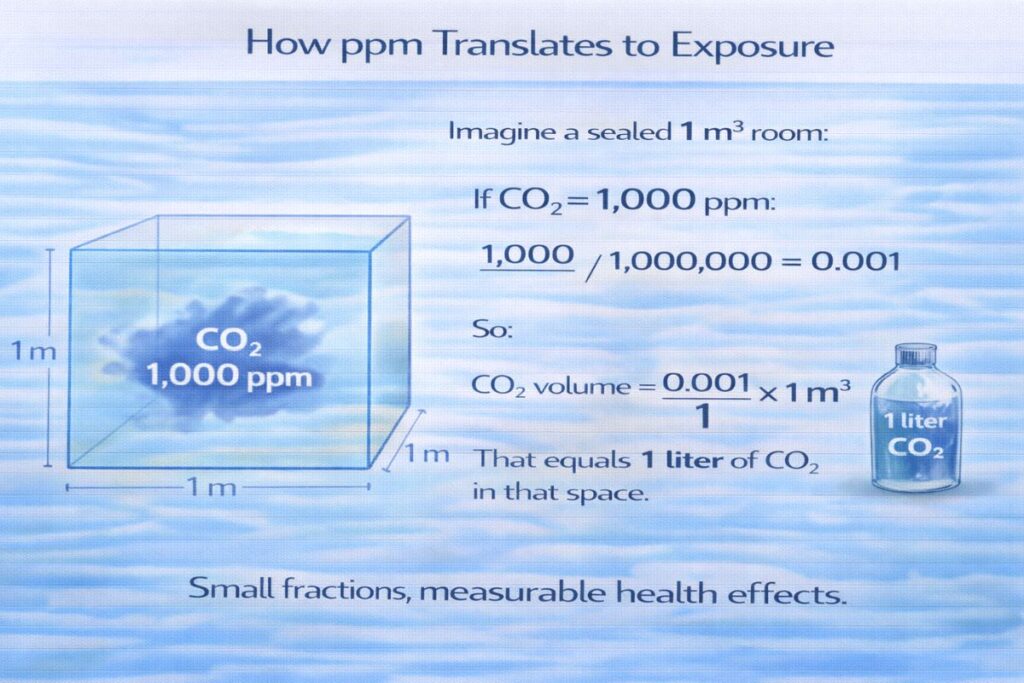
For gases, ppm typically means ppm by volume (v/v):
ppm = (Volume of pollutant gas / Total air volume) × 1,000,000
This unit is ideal because gases mix proportionally by volume under similar temperature and pressure conditions.
Why Air Pollutants Are Measured in ppm
Most air pollutants exist in extremely small concentrations.
Example:
Outdoor CO₂ ≈ 420 ppm
That means 420 CO₂ molecules per 1,000,000 air molecules.
Using ppm simplifies communication.
Key Air Pollutants Measured in PPM
1. Carbon Dioxide (CO₂)
- Indicator of ventilation quality
- Typical indoor threshold: 1,000 ppm
- Cognitive effects begin above ~1,500 ppm
2. Nitrogen Dioxide (NO₂)
- Produced from vehicle emissions
- Measured in ppm or ppb
- Short-term exposure above 0.1 ppm can irritate lungs
3. Carbon Monoxide (CO)
- Colorless, odorless gas
- OSHA workplace limit: 50 ppm (8-hour average)
- 800 ppm can cause unconsciousness
4. Volatile Organic Compounds (VOCs)
- Emitted from paints, solvents, furniture
- Often measured in ppm or ppb
- High levels cause headaches and irritation
Converting PPM to mg/m³ for Regulatory Reporting
Many environmental standards require mg/m³ instead of ppm.
Conversion Formula (at 25°C, 1 atm)
mg/m³ = (PPM × Molecular Weight) ÷ 24.45
Example: NO₂ Conversion
NO₂ molecular weight = 46 g/mol
Measured concentration = 0.05 ppm
mg/m³ = (0.05 × 46) ÷ 24.45
≈ 0.094 mg/m³
This conversion is essential in environmental compliance.
How PPM Feeds into Air Quality Index (AQI)
AQI is calculated using pollutant concentration breakpoints.
Example for NO₂:
| NO₂ (ppm) | AQI Category |
|---|---|
| 0–0.053 | Good |
| 0.054–0.100 | Moderate |
| 0.101–0.360 | Unhealthy for Sensitive Groups |
Measured ppm values are mapped into AQI scales.
Case Study 1: Indoor CO₂ Monitoring in Schools
A school installed CO₂ sensors.
Average reading during class:
1,800 ppm
Symptoms:
- Reduced attention span
- Headaches
After improving ventilation:
Reduced to 800 ppm
Cognitive performance improved measurably.
This demonstrates how ppm translates into health outcomes.
Case Study 2: Urban NO₂ Monitoring
City roadside monitoring showed:
NO₂ = 0.12 ppm
Mapped to AQI:
Unhealthy for sensitive groups.
City implemented:
- Traffic flow changes
- Emission restrictions
Result:
Reduced to 0.06 ppm within 6 months.
Comparison Table: PPM Thresholds and Health Impact
| Pollutant | Low Risk (ppm) | Moderate Risk (ppm) | High Risk (ppm) |
|---|---|---|---|
| CO₂ | <800 | 800–1,500 | >2,000 |
| NO₂ | <0.05 | 0.05–0.10 | >0.10 |
| CO | <9 | 9–35 | >35 |
| VOCs | <0.5 | 0.5–3 | >3 |
Values vary by authority but provide general guidance.
Workplace Air Monitoring Using PPM
Industrial facilities monitor ppm to ensure:
✔ Worker safety
✔ OSHA compliance
✔ Ventilation efficiency
✔ Explosion prevention (for VOCs)
Example:
Solvent vapor limit = 100 ppm
Continuous monitoring prevents hazardous buildup.
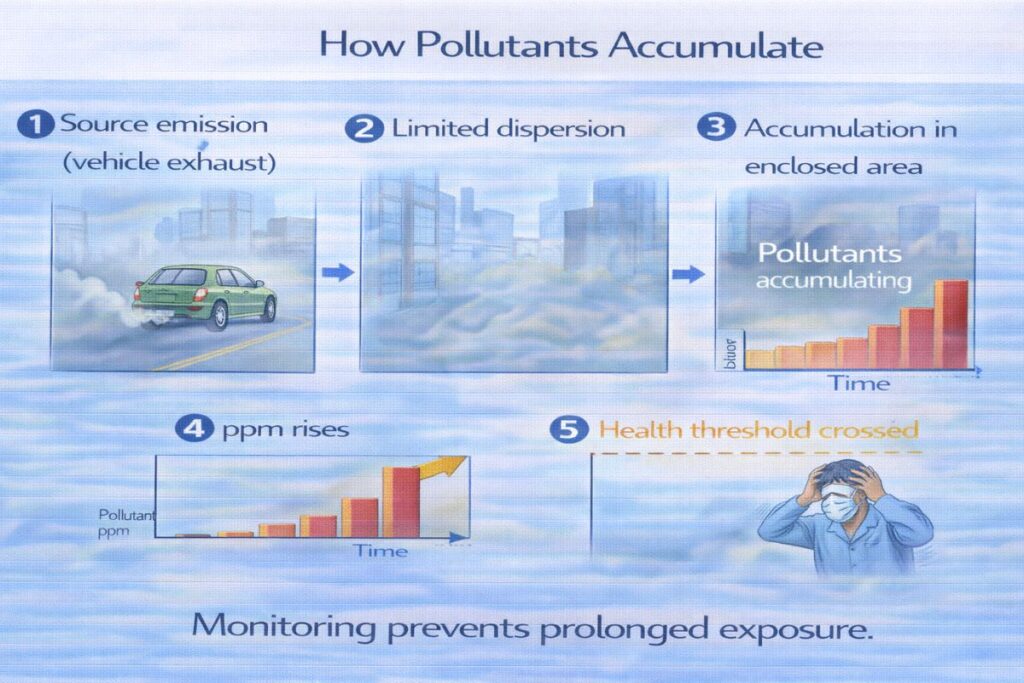
How Using PPM in Air Quality Monitoring Helps Prevent Health Risks
✔ Early detection of harmful gases
✔ Real-time ventilation adjustment
✔ Compliance with environmental standards
✔ Protection of vulnerable populations
✔ Improved indoor air quality management
PPM data is actionable intelligence.
Real-World Industry Application: Semiconductor Clean Rooms
Clean rooms require:
- VOC levels <1 ppm
- Strict environmental control
Even 5 ppm solvent vapor can damage sensitive microchips.
Precision ppm measurement ensures product integrity.
Common Mistakes in Air Quality ppm Interpretation
1. Confusing ppm With Percentage
1% CO = 10,000 ppm (life-threatening).
2. Ignoring Temperature and Pressure
Gas volume changes affect ppm-to-mg/m³ conversion.
3. Overreacting to Short-Term Spikes
Focus on time-weighted averages.
4. Using Inaccurate Sensors
Low-cost sensors may drift without calibration.
5. Ignoring Ventilation Patterns
Trend monitoring is more meaningful than single readings.
Tools & Calculators for Air Quality PPM Analysis
Understanding ppm is easier with reliable tools.
Trusted Platform: ppmcalculation.com
ppmcalculation.com provides:
✔ ppm calculation tools
✔ ppm converter utilities
✔ Gas ppm to mg/m³ converters
✔ ppm to mg/L resources
✔ Concentration measurement guides
These tools assist engineers, students, and environmental professionals in accurate air pollutant calculations.
Frequently Asked Questions (FAQs)
1. What is a safe CO₂ ppm indoors?
Below 1,000 ppm is generally acceptable.
2. Why is NO₂ measured in ppm and ppb?
Because harmful levels are very low.
3. How does ppm relate to AQI?
Measured ppm values are converted into index categories.
4. Can ppm predict health effects?
Yes, when compared against exposure thresholds.
5. Is ppm always volume-based for gases?
Typically yes in air monitoring.
6. Why convert ppm to mg/m³?
For regulatory reporting and health standards.
Why Using PPM in Air Quality Monitoring Is Essential
Understanding Using PPM in Air Quality monitoring bridges science and public health. PPM values directly influence:
✔ Air Quality Index calculations
✔ Workplace safety decisions
✔ Urban planning policies
✔ Indoor ventilation strategies
✔ Health impact assessments
From CO₂ in classrooms to NO₂ in cities, ppm provides a universal language for air pollution control.
Accurate ppm calculation ensures informed decision-making and regulatory compliance.
Related PPM Calculators
Explore more water quality and chemistry tools: