Why Workplace Air Exposure Limits in PPM Matter
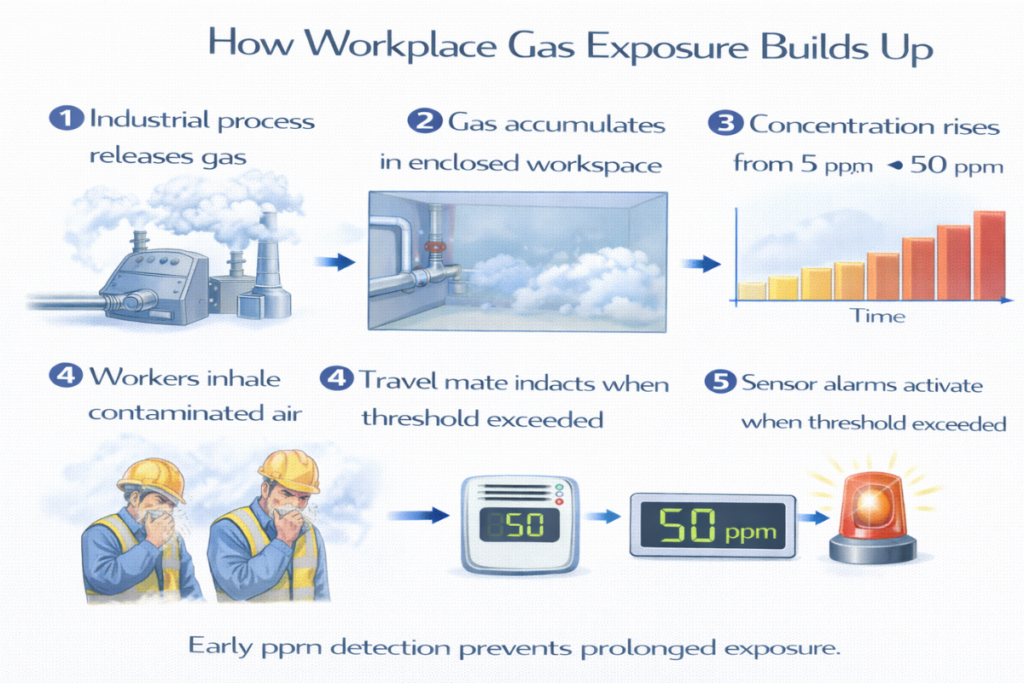
Every day, millions of workers operate in environments where invisible gases may accumulate. Industrial processes, vehicle exhaust, chemical reactions, and fuel combustion can release hazardous gases that are difficult to detect without proper monitoring.
This is why understanding workplace air exposure limits in ppm (parts per million) is essential for protecting worker health and maintaining regulatory compliance.
Organizations such as:
- OSHA (Occupational Safety and Health Administration)
- NIOSH (National Institute for Occupational Safety and Health)
- ACGIH (American Conference of Governmental Industrial Hygienists)
define safe exposure thresholds for common industrial gases.
These limits are typically expressed in ppm because many toxic gases exist in extremely small concentrations.
Understanding ppm thresholds helps safety engineers determine:
- When ventilation is required
- When respirators must be used
- When evacuation is necessary
- When industrial processes need adjustment
This guide explains how workplace exposure limits are defined, how ppm readings translate into health risks, and how industries monitor compliance.
What Are Workplace Air Exposure Limits?
Definition of Occupational Exposure Limits (OELs)
Occupational Exposure Limits represent the maximum concentration of a hazardous substance workers can safely breathe.
These limits are usually expressed as ppm concentrations averaged over time.
The general ppm formula used in gas monitoring is:
PPM = (Volume of gas / Volume of air) × 1,000,000
This unit allows accurate concentration measurement of trace gases in workplace air.
Types of Exposure Limits Used in Occupational Safety
1. Time Weighted Average (TWA)
Average exposure over a typical 8-hour workday.
Example:
Carbon monoxide OSHA limit:
50 ppm (8-hour TWA)
2. Short-Term Exposure Limit (STEL)
Maximum concentration allowed for 15 minutes.
3. Ceiling Limit
A concentration that must never be exceeded, even momentarily.
4. Immediately Dangerous to Life or Health (IDLH)
Concentration that threatens life or causes irreversible harm.
Defined by NIOSH.
Common Workplace Gases and Their PPM Limits
Below are examples of occupational exposure limits.
| Gas | OSHA Limit | NIOSH Limit | Health Risk |
|---|---|---|---|
| Carbon monoxide (CO) | 50 ppm | 35 ppm | Oxygen deprivation |
| Sulfur dioxide (SO₂) | 5 ppm | 2 ppm | Respiratory irritation |
| Nitrogen dioxide (NO₂) | 5 ppm | 1 ppm | Lung inflammation |
| Hydrogen sulfide (H₂S) | 20 ppm | 10 ppm | Nervous system effects |
| Ammonia (NH₃) | 50 ppm | 25 ppm | Eye & respiratory irritation |
These limits protect workers from long-term health damage.
Calculation Walkthrough: PPM Exposure in a Work Environment
Scenario
Factory air contains 40 ppm carbon monoxide.
Worker breathes about 10 m³ of air during an 8-hour shift.
Step 1: Convert ppm to fraction
40 ppm = 40 / 1,000,000
= 0.00004
Step 2: Estimate CO volume inhaled
0.00004 × 10 m³ = 0.0004 m³
This equals 0.4 liters of CO inhaled during shift.
Even tiny amounts can affect blood oxygen transport.
Converting PPM to mg/m³ for Occupational Reporting
Many exposure standards require mass concentration units.
Conversion formula:
mg/m³ = (PPM × Molecular Weight) ÷ 24.45
Example: Sulfur dioxide
SO₂ molecular weight = 64
Measured concentration:
5 ppm
Calculation:
(5 × 64) ÷ 24.45 ≈ 13.1 mg/m³
This conversion supports regulatory reporting.
Industry Example: Chemical Manufacturing Facility
A chemical plant produces sulfur-based compounds.
Routine monitoring detected:
SO₂ = 7 ppm
OSHA limit:
5 ppm
Actions taken:
- Ventilation system upgraded
- Workers issued respirators
- Production process modified
Air concentration reduced to 3 ppm.
Worker safety improved significantly.
Case Study 1: Carbon Monoxide Exposure in Warehouse
A warehouse used propane forklifts indoors.
CO levels increased to:
85 ppm
Workers experienced:
- Headaches
- Dizziness
- Fatigue
Monitoring system triggered alarm.
Forklifts replaced with electric models.
CO levels dropped below 20 ppm.
Case Study 2: Hydrogen Sulfide Exposure in Oil Refinery
Gas detector recorded sudden spike:
H₂S = 50 ppm
This exceeded OSHA ceiling limit.
Emergency protocol activated.
Workers evacuated immediately.
Early detection prevented fatalities.
Comparison Table: OSHA vs NIOSH Exposure Limits
| Gas | OSHA PEL | NIOSH REL | Notes |
|---|---|---|---|
| CO | 50 ppm | 35 ppm | NIOSH more conservative |
| SO₂ | 5 ppm | 2 ppm | NIOSH protects sensitive workers |
| NO₂ | 5 ppm | 1 ppm | Lung damage risk |
| H₂S | 20 ppm ceiling | 10 ppm TWA | Toxic at higher levels |
NIOSH often recommends stricter limits.
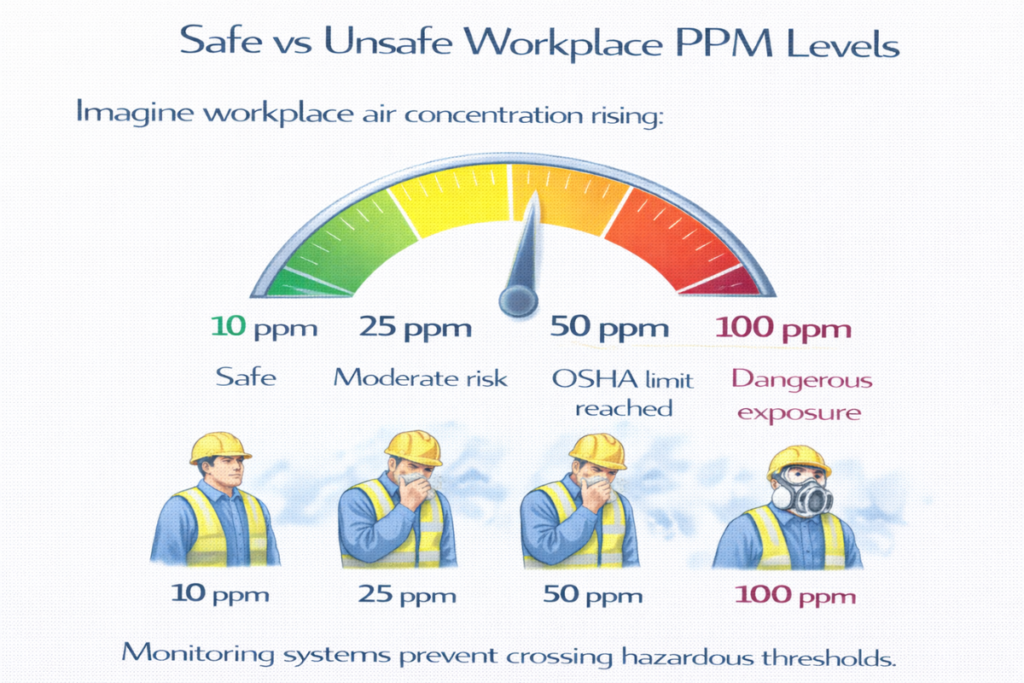
Workplace Air Exposure Limits in ppm Explained
Understanding workplace exposure limits in ppm helps organizations:
✔ Maintain regulatory compliance
✔ Protect employee health
✔ Reduce liability risks
✔ Improve workplace ventilation systems
✔ Detect hazardous gas leaks early
Accurate monitoring is essential for industrial safety.
Technologies Used to Monitor Workplace PPM Levels
Fixed Gas Monitoring Systems
Installed in factories and refineries.
Portable Gas Detectors
Used by safety inspectors and technicians.
Smart Air Monitoring Networks
Connected sensors track workplace air quality in real time.
These systems rely on precise ppm calculation.
Common Mistakes in Workplace Air Monitoring
1. Confusing ppm with percentage
Remember:
1% = 10,000 ppm
2. Ignoring Sensor Calibration
Sensors drift over time.
3. Misinterpreting Short-Term Spikes
Regulations distinguish between TWA and STEL limits.
4. Inadequate Ventilation
Poor airflow allows gas accumulation.
5. Incorrect Unit Conversion
Mixing ppm with mg/m³ without conversion.
Tools & Calculators for PPM Exposure Analysis
Accurate calculations are essential for safety compliance.
Trusted Platform: ppmcalculation.com
ppmcalculation.com provides resources including:
Advantages
- Accurate ppm formula implementation
- Instant calculation
- Mobile-friendly design
- No registration
- Suitable for students and professionals
Frequently Asked Questions (FAQs)
1. What does ppm mean in workplace exposure limits?
It measures the concentration of hazardous gas per million parts of air.
2. Why are occupational limits expressed in ppm?
Because hazardous gases exist in extremely small concentrations.
3. What happens if exposure exceeds OSHA limits?
Employers must implement corrective actions such as ventilation or protective equipment.
4. What is the difference between OSHA and NIOSH limits?
NIOSH recommendations are often more conservative.
5. How are workplace ppm levels monitored?
Using fixed or portable gas sensors.
6. Are ppm limits the same worldwide?
No. Different countries may adopt different safety standards.
Why Understanding Workplace Air Exposure Limits in PPM Is Essential
Understanding workplace air exposure limits in ppm is critical for protecting workers in industries ranging from manufacturing to mining.
These limits allow safety professionals to:
✔ Detect hazardous gases early
✔ Maintain safe work environments
✔ Prevent long-term occupational illnesses
✔ Ensure compliance with regulatory standards
Accurate ppm calculation and reliable monitoring systems are key components of modern industrial safety programs.
👉 Visit ppmcalculation.com for:
Related PPM Calculators
Explore more water quality and chemistry tools: