
PPM to Percent (%) Converter
Percent expresses a value per 100 units, while PPM expresses a value per 1,000,000 units.
The conversion formula is:
Percent (%) = PPM ÷ 10,000
Example: 1,000 PPM = 0.1%
PPM to Percent Formula
Percent (%) represents parts per hundred, while PPM represents parts per million.
Percent (%) = PPM ÷ 10,000
Example: 2500 PPM ÷ 10,000 = 0.25%
PPM to Percent Conversion Explained
The PPM to percent conversion is commonly used in chemistry, environmental monitoring, nutrient analysis, toxicology, and industrial process control. Parts per million (PPM) is a unit that describes extremely small concentrations, while percent (%) is a broader unit used for higher or more general concentration levels. Understanding how to convert PPM to percent is essential when comparing laboratory results, preparing chemical solutions, or interpreting safety guidelines.
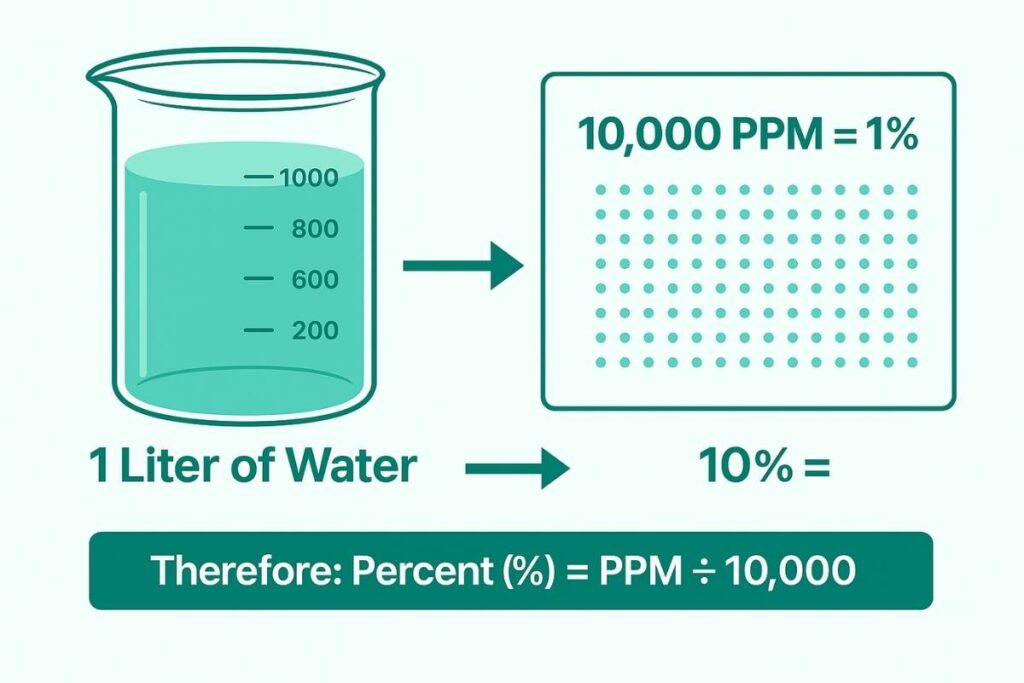
How PPM Relates to Percent
One percent represents one part out of one hundred, while one PPM represents one part out of one million. Because percent measures concentration per hundred units and PPM measures concentration per million units, the conversion between them is straightforward. Since one percent equals 10,000 PPM, even relatively small percent values correspond to very large PPM values.
Where This Conversion Is Used
Professionals convert PPM to percent when communicating results to non-technical audiences, preparing chemical mixtures, calibrating dosing equipment, or simplifying high-PPM values into percentages. Industries such as agriculture, environmental science, air and water quality analysis, HVAC, and food chemistry rely heavily on this conversion.
Why a Calculator Helps
Although the formula is simple, manually converting very large or very small values can be prone to error. A calculator ensures consistent and accurate results when converting PPM to percent, especially when working with multi-step chemical calculations or compliance reporting. This tool is designed to make the conversion instant, reliable, and intuitive for both scientific and general usage.