
PPM to mg/L Converter
mg/L = PPM × Density (kg/L)
For water (density = 1.0 kg/L), PPM and mg/L are numerically equal.
PPM to mg/L Formula
For water-based solutions:
mg/L = PPM × 1
For other liquids:
mg/L = PPM × Density (kg/L)
PPM to mg/L Conversion Explained
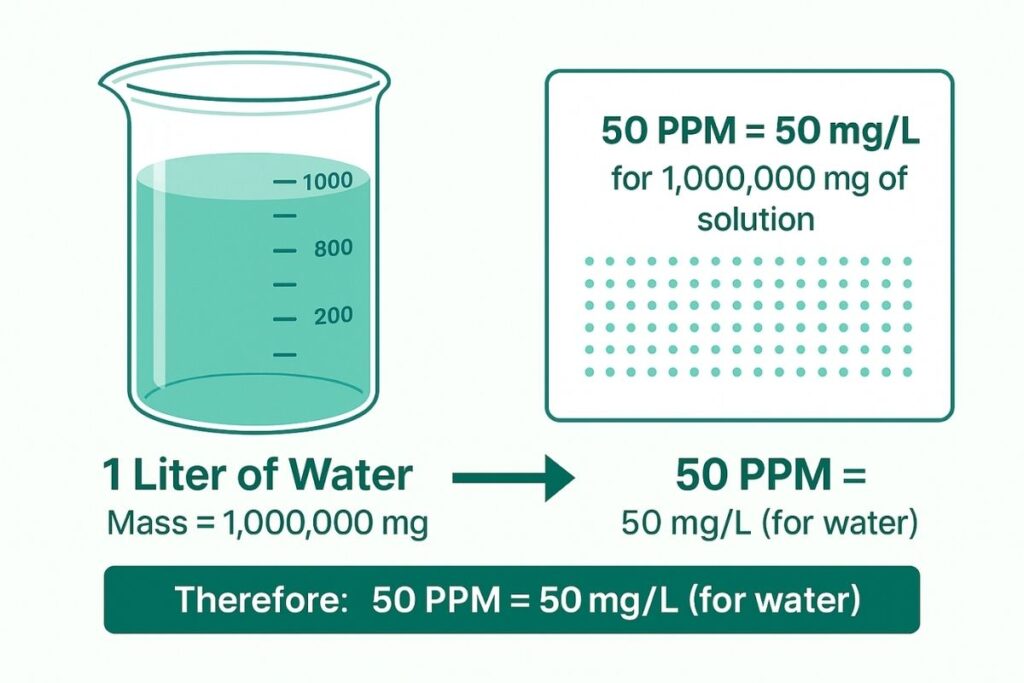
The conversion from PPM to mg/L is one of the most widely used calculations in water chemistry, hydroponics, environmental monitoring, nutrient analysis, and laboratory testing. Both units measure solute concentration, but mg/L expresses the mass of a substance per liter of solution, while PPM expresses the mass per million parts of solution. In water, these two units match closely because 1 liter of water has a mass of approximately 1 kilogram, or one million milligrams.
Why PPM Equals mg/L in Water
For dilute aqueous solutions, density plays a key role. Pure water at standard temperature has a density of about 1 kg/L, meaning one liter weighs one million milligrams. Because PPM represents 1 milligram of solute per million milligrams of solution, the numerical values for PPM and mg/L become identical. This makes converting PPM to mg/L extremely simple for water-based systems such as drinking water testing, hydroponic nutrient measurement, aquaculture, and swimming pool chemistry.
When PPM Does Not Equal mg/L
While the 1:1 relationship is accurate for water, other liquids with different densities require adjustment. In oil-based solutions, concentrated chemical mixtures, or industrial solvents, PPM must be calculated by accounting for the liquid’s density. In such cases, converting PPM to mg/L without including density would yield inaccurate results. This is why advanced calculators include a density parameter to ensure precision across all applications.
Where This Conversion Is Commonly Used
The PPM to mg/L calculation is essential in multiple scientific and industrial fields. Water quality professionals use it to determine dissolved solids, contaminants, and treatment levels. Hydroponic growers rely on it to maintain optimal nutrient concentrations. Chemists use mg/L to express solubility and solution strength, while environmental agencies use PPM to regulate pollutants. Because these applications depend on accurate concentration values, a reliable PPM to mg/L converter is crucial.
Why Use a Calculator Instead of Manual Conversion
Even though the formula is straightforward in water, professional measurements often require more accuracy. A PPM to mg/L converter reduces calculation errors, speeds up workflow, and allows density corrections when needed. This is especially important in laboratory environments, where precise values influence testing outcomes, reporting accuracy, and regulatory compliance.