Why PPM in Food Safety Is Critical for Consumer Protection
Food safety depends on detecting extremely small amounts of contaminants before they reach consumers. Many harmful substances in food—such as pesticide residues, heavy metals, veterinary drug residues, and additives—exist in very small concentrations. Scientists measure these concentrations using parts per million (ppm).
Understanding PPM in Food Safety is essential because even trace levels of contaminants can affect public health. Governments and regulatory agencies worldwide rely on ppm-based standards to determine whether food is safe for consumption.
For example:
- Maximum pesticide residue in vegetables may be limited to 0.5 ppm
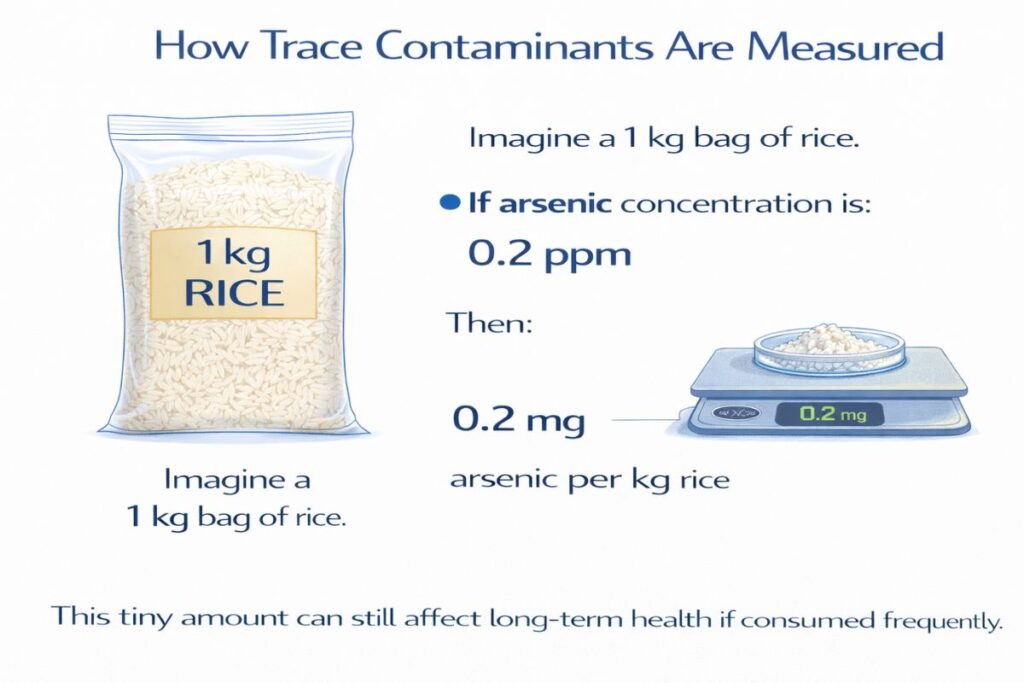
- Arsenic in rice may be regulated below 0.2 ppm
- Nitrite additives in processed meat may be limited to 200 ppm
Food laboratories perform precise concentration measurement and ppm calculation to ensure that food products comply with these strict limits.
This article explains how ppm works in food safety testing, how regulators define acceptable limits, how to calculate ppm in food samples, and how testing prevents contaminated products from entering the food supply.
What Is PPM in Food Safety?
Definition of Parts Per Million in Food Analysis
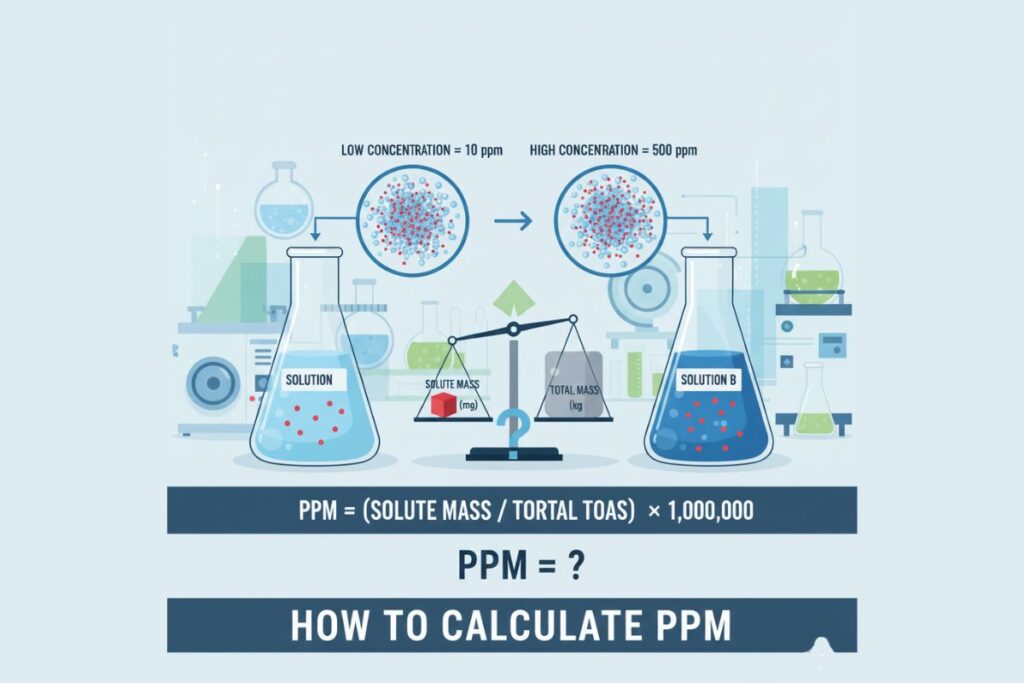
In food chemistry, parts per million (ppm) represents the mass of a contaminant relative to the total mass of the food sample.
Standard ppm formula:
PPM = (Mass of contaminant / Mass of food sample) × 1,000,000
For solid food:
1 ppm = 1 mg/kg
For liquids:
1 ppm ≈ 1 mg/L
This makes ppm ideal for measuring trace contaminants.
Why PPM Is Used in Food Testing
Food contaminants usually exist at very low levels.
Examples:
- 0.05 ppm pesticide residue
- 0.01 ppm mercury in fish
- 50 ppm preservative in beverages
Using ppm allows precise monitoring without cumbersome decimal numbers.
Types of Contaminants Measured in PPM
1. Pesticide Residues
Agricultural pesticides protect crops but must remain below safe limits.
Example limits:
| Pesticide | Maximum Residue Level |
|---|---|
| Chlorpyrifos | 0.5 ppm |
| Glyphosate | 1–5 ppm |
| Carbendazim | 0.1 ppm |
These limits are known as MRLs (Maximum Residue Limits).
2. Heavy Metals
Heavy metals accumulate in soil and water and can enter food chains.
Common contaminants include:
- Lead (Pb)
- Mercury (Hg)
- Cadmium (Cd)
- Arsenic (As)
Example limits:
| Metal | Typical Limit |
|---|---|
| Lead | <0.1 ppm |
| Arsenic | <0.2 ppm |
| Mercury | <0.5 ppm |
3. Food Additives
Additives improve flavor, preservation, and appearance but must remain within regulated ppm ranges.
Examples:
| Additive | Typical ppm Range |
|---|---|
| Sodium nitrite | 100–200 ppm |
| Sulfur dioxide | 10–100 ppm |
| Benzoate preservatives | 100–1,000 ppm |
4. Veterinary Drug Residues in Animal Feed
Animals treated with antibiotics may leave residues in meat or milk.
Limits are often extremely low.
Example:
Tetracycline in milk:
<0.1 ppm
Laboratory Methods for Detecting PPM in Food
Food safety laboratories use advanced analytical techniques.
1. Gas Chromatography (GC-MS)
Used for pesticide residue detection.
2. High Performance Liquid Chromatography (HPLC)
Detects additives and veterinary drugs.
3. ICP-MS (Inductively Coupled Plasma Mass Spectrometry)
Measures heavy metals at extremely low ppm or ppb levels.
These instruments ensure accurate concentration measurement.
Calculation Walkthrough: PPM in Food Sample
Example 1: Pesticide Residue
A lab analyzes a 500 g apple sample.
Detected pesticide = 0.05 mg.
Step 1: Convert grams to kilograms
500 g = 0.5 kg
Step 2: Apply ppm formula
PPM = (0.05 mg / 0.5 kg)
Step 3:
PPM = 0.1 ppm
If regulatory limit = 0.5 ppm, the sample passes safety standards.
Case Study 1: Pesticide Contamination in Imported Vegetables
A shipment of spinach was tested at port inspection.
Detected pesticide level:
0.8 ppm
Regulatory limit:
0.5 ppm
Result:
Shipment rejected and destroyed.
Testing prevented contaminated produce from reaching consumers.
Case Study 2: Mercury Monitoring in Fish
A seafood supplier tested tuna samples.
Measured mercury:
0.4 ppm
Limit for human consumption:
1 ppm
Fish were safe but labeled with consumption advisories.
Regular monitoring ensured compliance.
Industry Example: Food Manufacturing Quality Control
Food processors test raw materials before production.
Example:
Chocolate manufacturer tests cocoa powder for cadmium.
Measured:
0.7 ppm
Maximum limit:
0.8 ppm
Batch accepted but supplier monitored closely.
PPM-based monitoring ensures product safety.
Comparison Table: PPM vs Other Concentration Units in Food
| Unit | Equivalent |
|---|---|
| 1 ppm | 1 mg/kg |
| 1 ppb | 0.001 ppm |
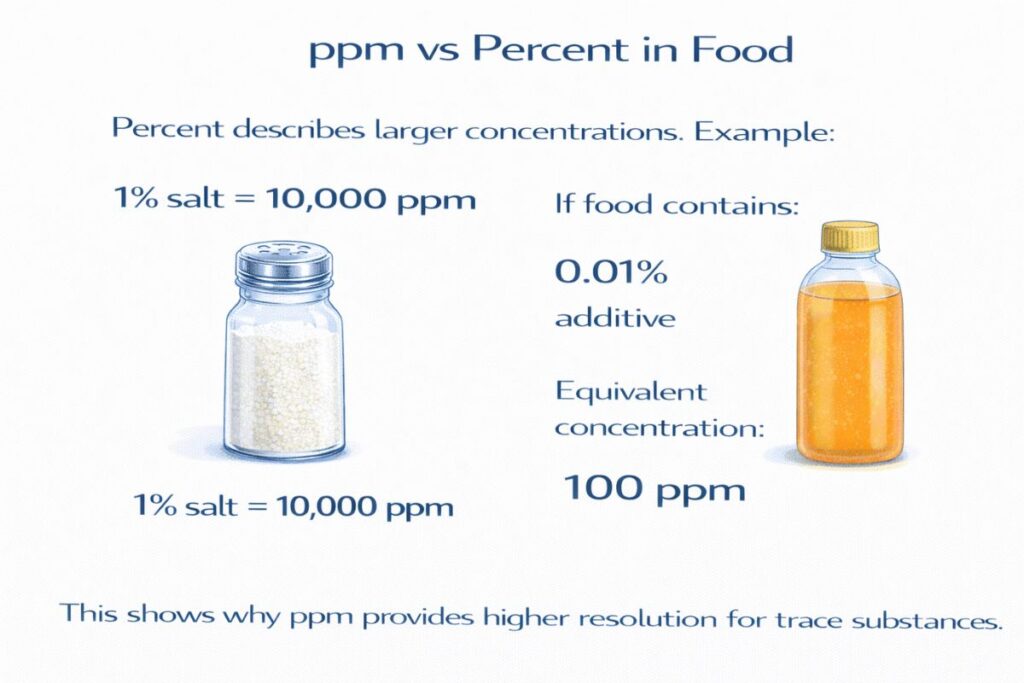
| 1% | 10,000 ppm |
| 1 mg/kg | 1 ppm |
These relationships help convert between units quickly.
How PPM in Food Safety Helps Detect Contaminants
Using ppm measurement allows:
✔ Early detection of pesticide residues
✔ Monitoring heavy metals in food
✔ Ensuring additive levels remain safe
✔ Preventing contaminated products from entering markets
✔ Enforcing international food safety regulations
Precise ppm monitoring protects consumers globally.
Global Food Safety Standards Using PPM
Regulatory agencies include:
- WHO (World Health Organization)
- FDA (United States Food and Drug Administration)
- EFSA (European Food Safety Authority)
- FSSAI (India Food Safety and Standards Authority)
These agencies define maximum contaminant levels using ppm thresholds.
Common Mistakes in PPM Food Testing
1. Confusing ppm with percent
Remember:
1 ppm = 0.0001%
2. Ignoring Sample Weight Conversion
Incorrect units lead to inaccurate results.
3. Improper Sample Preparation
Contamination during handling affects accuracy.
4. Misinterpreting Detection Limits
Some instruments detect ppb rather than ppm.
5. Incorrect Unit Conversion
Mixing mg/kg with mg/L without understanding context.
Tools & Calculators for Food Safety PPM Analysis
Manual calculations increase the risk of reporting errors.
Trusted Platform: ppmcalculation.com
ppmcalculation.com provides tools for accurate concentration measurement including:
Advantages
- Accurate ppm formula implementation
- Instant calculation
- Mobile-friendly design
- No registration
- Suitable for students and professionals
Frequently Asked Questions (FAQs)
1. What does ppm mean in food safety?
It measures the concentration of contaminants per million parts of food.
2. Is 1 ppm dangerous?
Not necessarily. Safety depends on the specific substance.
3. Why are pesticide residues allowed in ppm?
Because trace levels may remain after agricultural use but must stay below safe thresholds.
4. How are ppm levels tested?
Using advanced laboratory techniques like GC-MS and ICP-MS.
5. What is the difference between ppm and ppb?
1 ppm equals 1,000 ppb.
6. Why is ppm used instead of percent?
Because contaminants exist at extremely small concentrations.
Why PPM in Food Safety Protects Public Health
Understanding PPM in Food Safety is essential for maintaining a safe global food supply.
PPM measurements allow scientists to:
✔ Detect contaminants at extremely low levels
✔ Enforce strict food safety regulations
✔ Monitor pesticide residues and heavy metals
✔ Ensure additives remain within safe limits
✔ Protect consumers from long-term exposure risks
Accurate ppm calculation ensures that food products remain safe, compliant, and trustworthy.
Ensure accurate concentration measurement in food safety testing.
👉 Visit ppmcalculation.com to access:
Related PPM Calculators
Explore more water quality and chemistry tools: