
PPM Dilution Calculator
Results
Stock Solution Needed (V₁): —
Amount of Diluent (Water): —
Understanding PPM Dilution
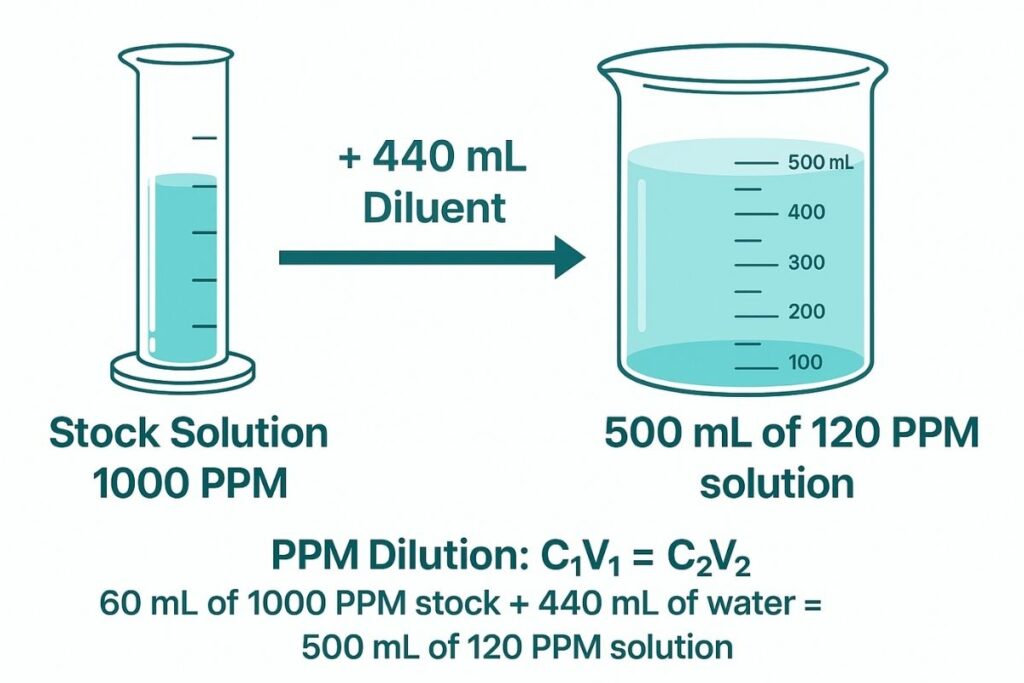
Dilution in terms of PPM refers to the process of reducing the concentration of a solute by mixing it with additional solvent. This is one of the most important calculations in analytical chemistry, water treatment, hydroponics, toxicology, and laboratory solution preparation. When a solution’s concentration is too high for a specific application, it must be diluted accurately—often by several orders of magnitude—to achieve a target PPM level.
What PPM Represents in Dilution Work
PPM (parts per million) expresses the mass ratio between solute and solution.
For aqueous solutions, PPM is numerically equivalent to mg/L, allowing chemists to treat dilution similarly to mass-per-volume calculations. Because dilution changes only the volume—not the mass of solute—the final concentration depends entirely on the total volume after dilution.
This relationship follows the fundamental dilution equation:
C₁ × V₁ = C₂ × V₂
Where:
C₁ = initial concentration (PPM)
V₁ = initial volume of concentrated solution
C₂ = final diluted concentration (PPM)
V₂ = final total volume after dilution
This equation is valid for any dilute solution where volumes are additive (ideal solution behavior).
Why Dilution Calculations Matter
Precise dilution is essential in laboratory analysis, nutrient calibration, chlorination, sample preparation for spectroscopy, environmental monitoring, and preparation of chemical standards. Even a small miscalculation can result in incorrect readings, poor crop performance, unsafe disinfection levels, or invalid laboratory measurements. A dilution calculator eliminates manual errors and ensures accurate, repeatable results.
Real-World Examples of PPM Dilution
Example 1 — Diluting a 5,000 PPM stock to 500 PPM
Initial solution:
C₁ = 5000 PPM
Target concentration:
C₂ = 500 PPM
Assume you want 1 liter of the final diluted solution (V₂ = 1 L = 1000 mL).
Using C₁V₁ = C₂V₂:
V₁ = (C₂ × V₂) / C₁
V₁ = (500 × 1000) / 5000
V₁ = 100 mL
This means:
Mix 100 mL of the 5000 PPM stock
With 900 mL of water
To obtain 1 L of 500 PPM solution
Example 2 — Diluting Chlorine from 12,000 PPM to 2,000 PPM
C₁ = 12,000
C₂ = 2,000
Assume you need 5 liters of final working solution:
V₂ = 5 L = 5000 mL
V₁ = (2000 × 5000) ÷ 12000
V₁ ≈ 833 mL
So you require:
833 mL concentrated chlorine
4167 mL water
To achieve a 2,000 PPM working concentration.
Example 3 — Creating Micro-dilutions (Toxicology)
If a chemist needs 10 PPM from a 10,000 PPM stock:
V₁ = (10 × 1000 mL) / 10,000
V₁ = 1 mL
Add 1 mL of stock to 999 mL solvent.
⭐ Why This Calculator Is Different
This tool does more than simple proportional math. It accounts for:
Direct C₁ → C₂ PPM dilution
Automatic volume calculation
Adjustable final volume
Laboratory-grade precision
Real-time validation
This makes it suitable for hydroponics, chemical standard preparation, environmental sampling, and analytical testing.
Industry-Specific PPM Dilution Notes
(Hydroponics, Water Treatment, Chlorine, Laboratories, Environmental Fields)
🌱 Hydroponics & Agriculture
Precise dilution ensures nutrient concentrations stay within safe and optimal ranges for plant growth. Even minor errors can cause nutrient burn, stunted growth, or deficiencies.
Common dilution uses:
- Reducing a strong nutrient stock (e.g., 3000 PPM) to working levels (600–900 PPM)
- Preparing mild solutions for seedlings (200–300 PPM)
- Adjusting EC/PPM after adding supplements
Typical nutrient ranges:
- Seedlings: 200–350 PPM
- Vegetative: 600–900 PPM
- Flowering: 1000–1200 PPM
💧 Water Treatment & Disinfection
Water treatment operators dilute disinfectants and chemical agents to meet strict regulatory safety limits. Chlorine and fluoride are the most frequently diluted chemicals.
Important notes:
- Chlorine concentrates (10,000–12,000 PPM) are commonly diluted to 1–4 PPM for household systems
- pH and temperature change chlorine effectiveness after dilution
- Use sealed containers — chlorine escapes quickly after mixing
🧪 Laboratory & Analytical Chemistry
Laboratories use PPM dilution to create calibration standards and prepare samples for instruments such as spectrophotometers and ICP analyzers.
Typical lab dilutions:
- 1000 PPM → 10 PPM standards
- 5000 PPM → 50 PPM environmental samples
A small dilution error can invalidate an entire test run, so accurate measurements using volumetric flasks and pipettes are essential.
🏭 Industrial Chemical Handling
Industrial applications dilute chemical concentrates for safe use in cooling towers, boilers, metal processing, and manufacturing.
Key notes:
- Always add chemical to water — never water to chemical
- High-viscosity chemicals need slow mixing for accuracy
- Industry formulas often use 1:50 or 1:100 ratios (convertible to PPM)
🏞️ Environmental Science & Monitoring
Environmental scientists dilute samples to measure trace contaminants in water, soil, and air. Proper dilution keeps samples within instrument detection range.
Applications:
- Bringing 10,000 PPM soil extract down to 100 PPM for testing
- Preparing heavy-metal dilution series
- Analyzing agricultural runoff
Common PPM Dilution Mistakes
❌ Mistake #1 — Forgetting the Basic Dilution Formula
Many users attempt to dilute solutions proportionally without applying the correct dilution equation. The only valid formula is:
C₁ × V₁ = C₂ × V₂
If this equation is not used, the final concentration will always be inaccurate.
❌ Mistake #2 — Mixing Units (mL vs L)
A very common error is mixing milliliters and liters in the same calculation. Because dilution ratios depend on volume, mixing units creates large concentration errors.
- 1000 mL = 1 L
- Always convert V₂ to the same unit before calculating
❌ Mistake #3 — Target Concentration Higher Than Initial
Dilution can only reduce concentration. A user cannot dilute a 500 PPM stock to achieve 2000 PPM — this is a common misunderstanding.
The rule: C₂ must always be lower than C₁.
❌ Mistake #4 — Incorrect Volume Subtraction
After calculating V₁ (the stock solution amount), many forget to subtract it from the final volume. The correct amount of diluent is:
Diluent Volume = V₂ − V₁
❌ Mistake #5 — Assuming Volume Additivity in All Chemicals
While water-based solutions are mostly additive, highly concentrated or viscous chemicals may not behave ideally.
- Acids and bases may generate heat when mixed
- Some industrial chemicals change density after dilution
- Always add chemical to water, not water to chemical