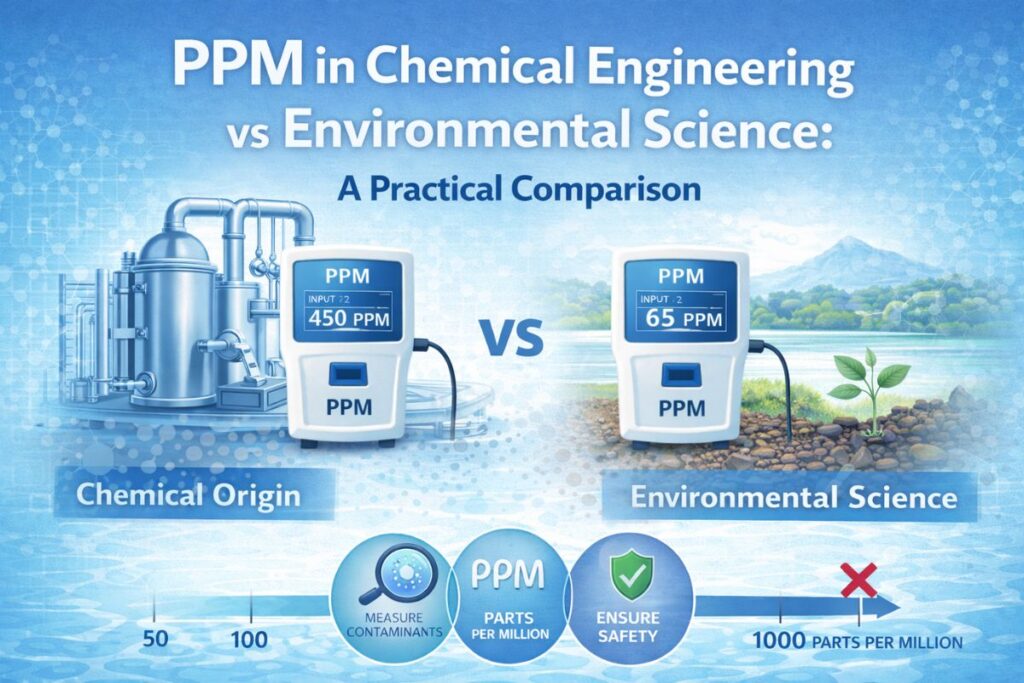
Why Knowing How to Convert PPM to Percent Matters
Whether you’re analyzing drinking water, formulating cosmetics, managing industrial processes, or studying environmental science, understanding how to convert PPM to percent and other units is essential. Misinterpreting concentration units can lead to:
- Incorrect chemical dosing
- Regulatory non-compliance
- Product quality failures
- Misleading laboratory reports
- Safety risks
Because parts per million (ppm) represents very small quantities, it often needs conversion into percent (%), mg/L, ppb (parts per billion), or mg/kg depending on the application.
This practical guide explains:
- The mathematical relationship between ppm and percent
- How ppm relates to mg/L in water
- How to convert ppm to ppb and vice versa
- Step-by-step worked examples
- Real-world case studies
- Common conversion mistakes
By the end, you’ll confidently perform any ppm conversion with clarity and precision.
Understanding PPM: A Quick Refresher
What Is PPM?
Parts per million (ppm) expresses one part of a substance per one million parts of a mixture.
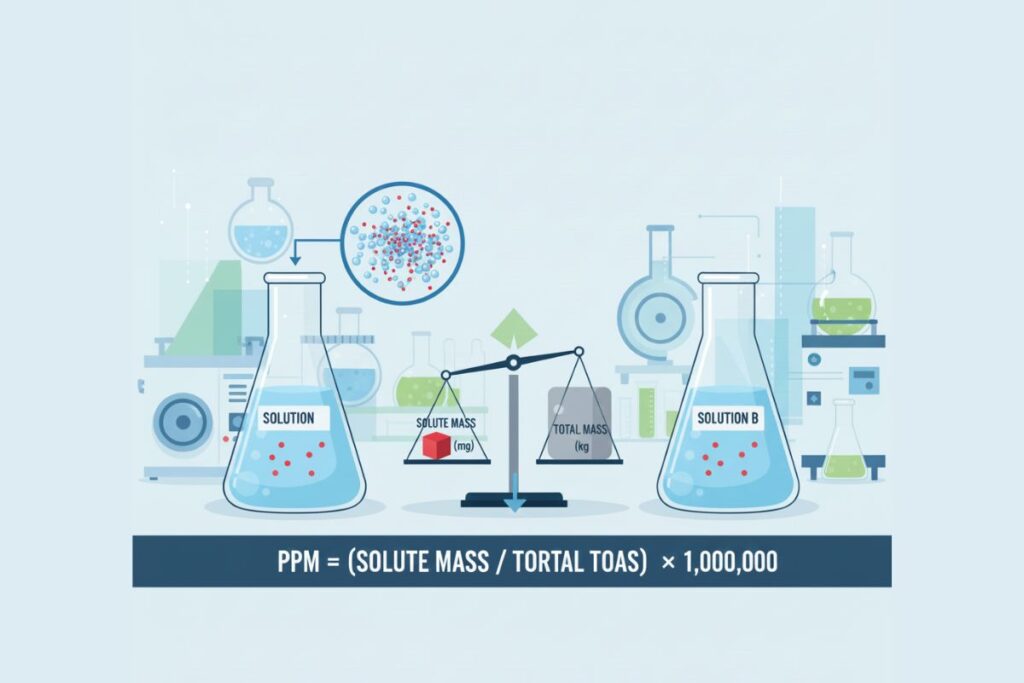
Standard PPM Formula
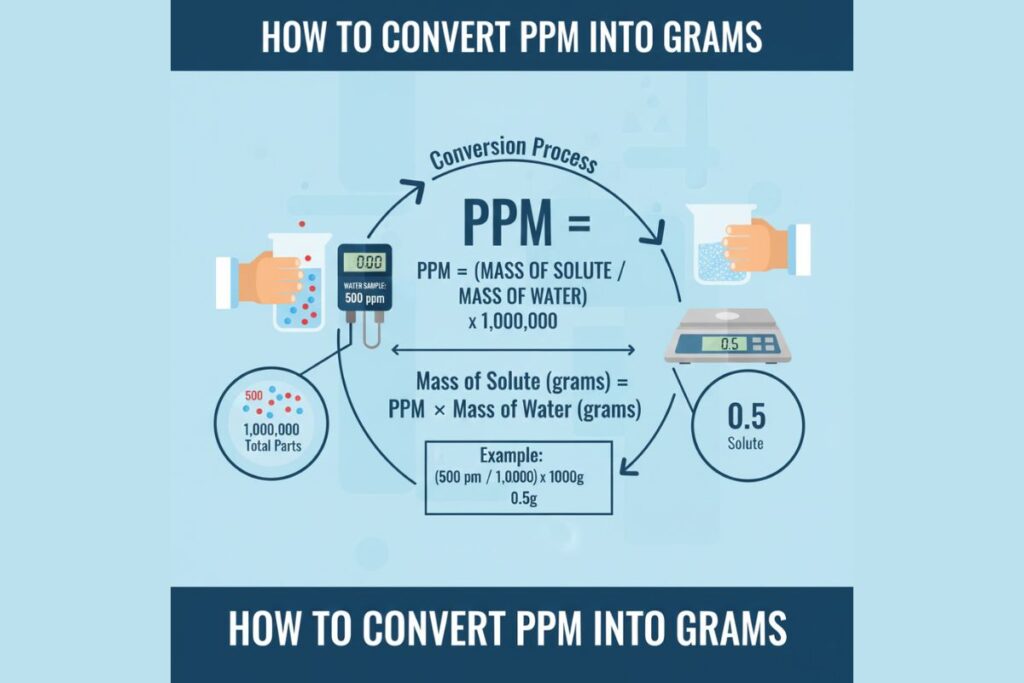
PPM = (Amount of solute / Total amount of mixture) × 1,000,000
In water systems:
1 ppm ≈ 1 mg/L
This approximation works because 1 liter of water weighs about 1 kilogram.
How to Convert PPM to Percent
Mathematical Relationship
Percent means parts per hundred.
PPM means parts per million.
Since:
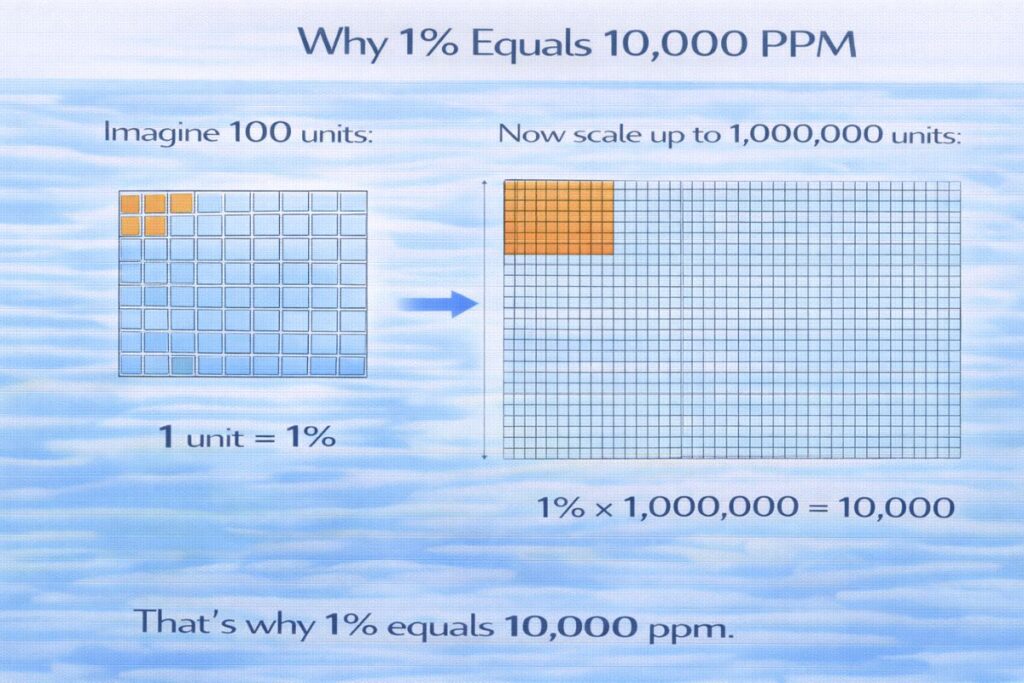
1% = 10,000 ppm
Therefore:
Percent = PPM ÷ 10,000
And:
PPM = Percent × 10,000
Worked Example 1: PPM to Percent
Given:
2,500 ppm
Step 1:
Percent = 2,500 ÷ 10,000
Step 2:
Percent = 0.25%
Worked Example 2: Percent to PPM
Given:
0.05%
Step 1:
PPM = 0.05 × 10,000
Step 2:
PPM = 500 ppm
How to Convert PPM to mg/L
Basic Rule (Water Only)
For water:
1 ppm = 1 mg/L
This works because:
- 1 L water ≈ 1 kg
- 1 kg = 1,000,000 mg
Worked Example 3: ppm to mg/L
Measured nitrate = 15 ppm
15 ppm = 15 mg/L
When Density Matters
If liquid density ≠ 1 kg/L:
PPM = mg/L ÷ density
Worked Example 4: Non-Water Liquid
Measured = 20 mg/L
Density = 1.2 kg/L
PPM = 20 ÷ 1.2
= 16.67 ppm
Ignoring density causes 20% error.
How to Convert PPM to PPB and PPT
Relationship Between Units
| Unit | Multiplier |
|---|---|
| 1 ppm | 1,000 ppb |
| 1 ppm | 1,000,000 ppt |
Conversion Formulas
PPB = PPM × 1,000
PPT = PPM × 1,000,000
Worked Example 5: PPM to PPB
Arsenic = 0.02 ppm
PPB = 0.02 × 1,000
= 20 ppb
Worked Example 6: PPB to PPM
Lead = 15 ppb
PPM = 15 ÷ 1,000
= 0.015 ppm
PPM to mg/kg (Solids)
For soil or food:
1 ppm = 1 mg/kg
Example 7: Soil Contamination
Lead concentration = 45 ppm
Equivalent to:
45 mg per kg soil
Gas Conversion (PPM to mg/m³)
For gases at 25°C and 1 atm:
mg/m³ = (PPM × Molecular Weight) ÷ 24.45
Worked Example 8: CO₂ Conversion
CO₂ = 800 ppm
Molecular weight = 44
mg/m³ = (800 × 44) ÷ 24.45
≈ 1,439 mg/m³
Gas conversions require temperature and pressure consideration.
Industry Case Study 1: Water Treatment Miscalculation
Plant operator confused:
10 ppm with 10%
Actual intended concentration:
10 ppm = 0.001%
Instead dosed 10%.
Result:
Chemical overdose by 10,000×
Lesson: Always verify unit conversion.
Industry Case Study 2: Environmental Compliance Reporting
Reported:
0.05 ppm arsenic
Regulatory requirement: ppb
Converted incorrectly as 0.05 ppb instead of:
0.05 ppm = 50 ppb
Underreported by 1,000×.
Comparison Table: Quick Conversion Reference
| From | To | Multiply/Divide |
|---|---|---|
| ppm → % | ÷10,000 | |
| % → ppm | ×10,000 | |
| ppm → mg/L (water) | ≈ same | |
| ppm → ppb | ×1,000 | |
| ppb → ppm | ÷1,000 | |
| ppm → ppt | ×1,000,000 |
How to Convert PPM to Percent Step-by-Step
✔ Identify unit
✔ Confirm mass or volume basis
✔ Apply correct multiplier
✔ Verify with logical check
✔ Cross-check using ppm calculator
Common Mistakes in PPM Conversion
1. Confusing ppm with percent
Remember:
1 ppm = 0.0001%
2. Ignoring Density
For non-water liquids.
3. Mixing Up ppb and ppm
Factor difference = 1,000.
4. Forgetting Temperature in Gas Conversion
Gas volume depends on conditions.
5. Rounding Too Early
Keep precision until final answer.
Tools & Calculators in the Digital Era
Manual ppm calculation was once done using slide rules.
Today, digital tools simplify the process.
Trusted Platform: ppmcalculation.com
ppmcalculation.com offers:
Advantages
- Accurate ppm formula implementation
- Instant calculation
- Mobile-friendly design
- No registration
- Suitable for students and professionals
The evolution of ppm now includes digital precision.
FAQs: How to Convert PPM to Percent and Other Units
1. What is 1 ppm in percent?
1 ppm = 0.0001%
2. Is ppm always equal to mg/L?
Only in water with density ≈1 kg/L.
3. How many ppm are in 1%?
1% = 10,000 ppm
4. How do I convert ppm to ppb?
Multiply by 1,000.
5. Why do regulators use ppb instead of ppm?
For highly toxic substances requiring stricter limits.
6. Can ppm apply to gases?
Yes, usually by volume basis.
Mastering How to Convert PPM to Percent and Beyond
Understanding how to convert PPM to percent and related units is essential for accurate scientific, industrial, and environmental work.
Key Takeaways
✔ 1% = 10,000 ppm
✔ 1 ppm = 0.0001%
✔ In water, 1 ppm ≈ 1 mg/L
✔ 1 ppm = 1,000 ppb
✔ Density affects conversions
✔ Digital tools reduce error
Accurate unit conversion ensures reliable concentration measurement and compliance.
Make every ppm conversion fast, accurate, and stress-free.
👉 Visit ppmcalculation.com today to access:
Related PPM Calculators
Explore more water quality and chemistry tools: