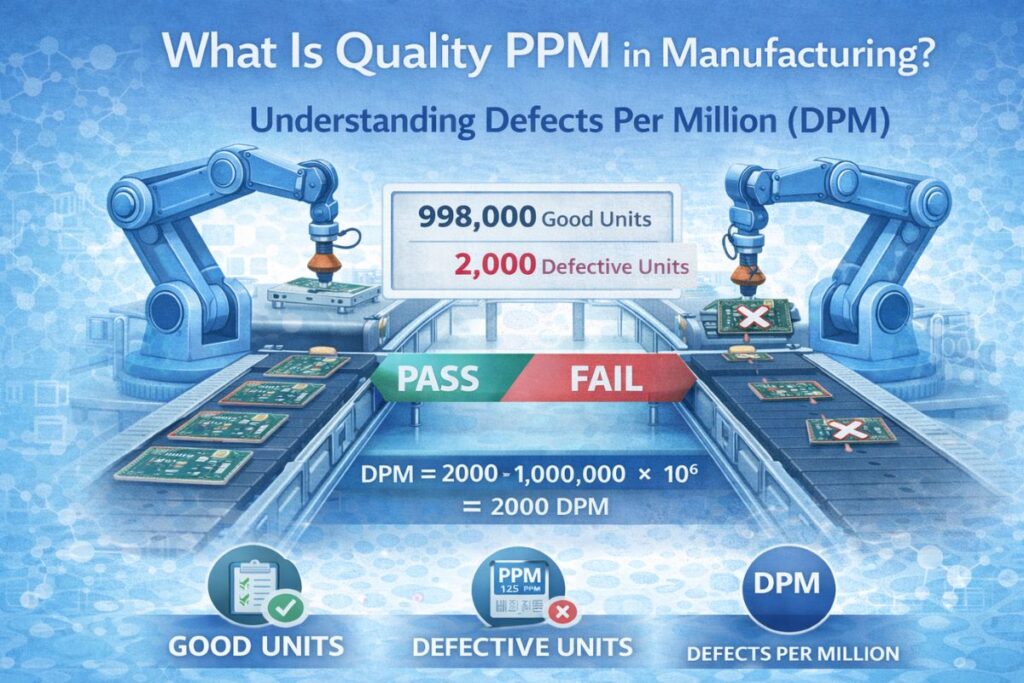
Understanding the failure rate of electronic components is crucial for ensuring product reliability, reducing warranty costs, and improving customer satisfaction. One of the most commonly used reliability metrics in the electronics industry is PPM, which stands for Parts Per Million. It is used to measure how many defective components are found in one million manufactured parts. A lower PPM value indicates higher manufacturing quality and better reliability.
What is PPM in Electronics Manufacturing
In electronics manufacturing, PPM stands for Parts Per Million and represents the number of defective components per one million manufactured units. It is used to measure reliability, production quality, and performance consistency. This metric is widely applied in semiconductor manufacturing, PCB assembly, consumer devices, automotive electronics, aerospace systems, and other critical electronic components.
PPM Formula for Electronics Component Failure
PPM = (Number of defective components / Total components produced) × 1,000,000
This formula helps manufacturers calculate defect rates either during production or after products are used in the field. It can be applied to batch sampling or full production output.
PPM Calculation Example
If a factory produced 500,000 resistors and 25 were found defective, the PPM is:
PPM = (25 / 500,000) × 1,000,000 = 50 PPM
A result of 50 PPM means that for every one million resistors, 50 are expected to fail, which indicates a relatively strong quality process.
Why PPM Is Important in Component Reliability
Monitoring PPM allows electronics companies to improve production control, analyze root causes of defects, manage warranties efficiently, and maintain compliance with international reliability standards. A very small increase in PPM could lead to thousands of failures once products reach customers, especially in high-volume manufacturing.
What Is a Good PPM Level in Electronics
Target PPM values depend on industry requirements:
Consumer electronics typically aim for 500 to 2000 PPM
Automotive electronics require less than 50 PPM
Aerospace and medical electronics demand ultra-low failure levels, usually below 10 PPM
Industries involving safety or human health require near-zero defects for long-term reliability.
PPM for Field Failures vs Factory Rejects
Defective components can be detected at two stages:
Manufacturing rejects detected during testing before shipment
Field failures that occur after real-world product usage
Tracking both is essential because components may pass testing but still fail later due to thermal stress, design flaws, poor soldering, or premature aging.
Reducing PPM in Electronics Manufacturing
Manufacturers can reduce PPM by improving inspection accuracy, performing supplier quality evaluations, applying design for manufacturability principles, using Six Sigma systems, performing environmental stress tests, and analyzing performance data to prevent recurring issues.
PPM vs DPMO in Electronics
PPM measures defective units per million components produced. DPMO, or Defects Per Million Opportunities, counts all possible failure points inside a single part. For complex systems like PCBs with thousands of connections, DPMO gives deeper insight. Both metrics are useful for improving precision and quality control in electronics production.
Conclusion
PPM is an important indicator of electronics component failure. It helps manufacturers understand defect levels, benchmark quality performance, and improve product reliability. By continuously monitoring and optimizing PPM, companies can reduce defects, minimize customer complaints, and deliver safer and more durable electronic products.