The Hidden Science Behind Everyday Products
Every day, you use products that contain dozens of chemical ingredients—shampoo, toothpaste, cosmetics, lotions, packaged foods, and even bottled water. Most of these ingredients are present in very small amounts, often measured in parts per million (ppm).
Understanding how ppm impacts everyday products is essential because even trace concentrations can influence:
- Product safety
- Skin sensitivity
- Shelf stability
- Regulatory compliance
- Long-term health effects
A preservative at 500 ppm behaves very differently from one at 5 ppm. A trace metal impurity at 2 ppm might be harmless in one product but unacceptable in another.
This article explains how ppm works in consumer goods, how manufacturers perform ppm calculation, how regulators set safe limits, and why trace chemical levels matter more than most people realize.
What Is PPM? A Practical Refresher
Parts per million (ppm) expresses one part of a substance in one million parts of a mixture.
Standard PPM Formula
PPM = (Mass of ingredient / Total mass of product) × 1,000,000
In liquids like water:
1 ppm ≈ 1 mg/L
This unit allows manufacturers to measure extremely small quantities accurately.
Why PPM Matters in Consumer Products
Manufacturers rely on ppm-level control for:
✔ Preservative effectiveness
✔ Fragrance concentration
✔ Heavy metal contamination
✔ Regulatory compliance
✔ Product stability
✔ Consumer safety
Even 10 ppm difference can determine whether a product passes safety testing.
How PPM Impacts Everyday Products: Product-by-Product Breakdown
1. Shampoo and Haircare Products
Shampoos contain:
- Preservatives
- Fragrances
- Stabilizers
- Trace impurities
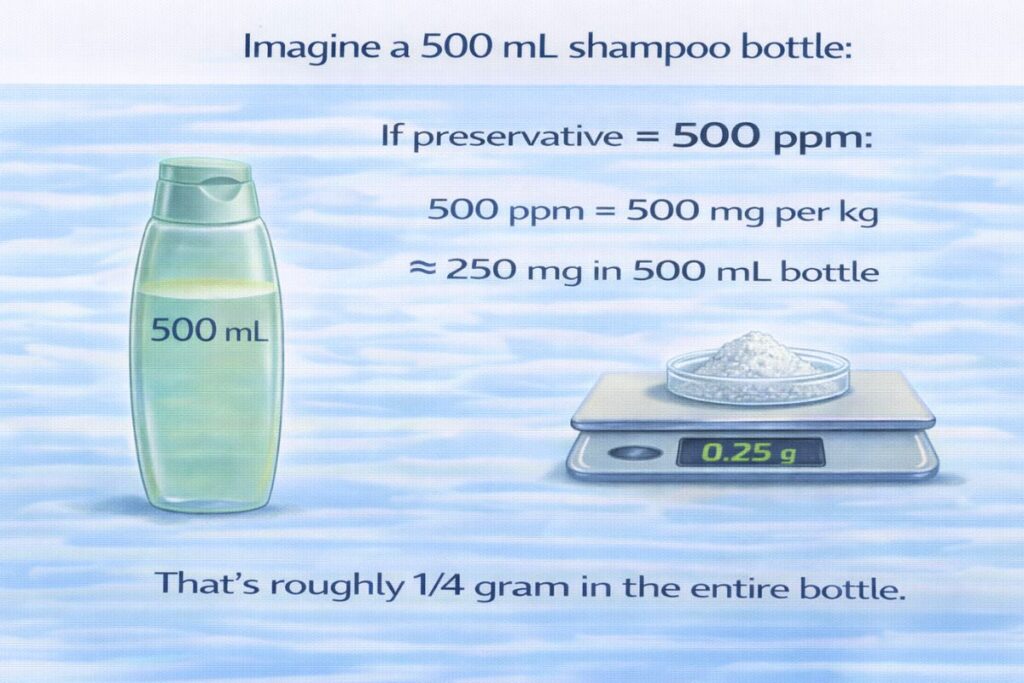
Example: Preservative Concentration
A common preservative may be used at 500–1,000 ppm.
Too low → microbial growth
Too high → scalp irritation
2. Cosmetics and Skincare Products
Cosmetics must control trace metals such as:
- Lead
- Arsenic
- Mercury
Regulatory agencies often set limits below 10 ppm.
Case Study: Lipstick Heavy Metal Testing
Testing revealed:
Lead concentration = 8 ppm
Legal limit = 10 ppm
Product approved but monitored.
Even small ppm levels matter due to daily exposure.
3. Toothpaste and Fluoride Levels
Fluoride concentration in toothpaste typically:
1,000–1,500 ppm
This level strengthens enamel while maintaining safety.
4. Packaged Foods and Beverages
Food additives often measured in ppm.
Example:
Preservative sodium benzoate = 100–300 ppm
Exceeding limits may cause regulatory action.
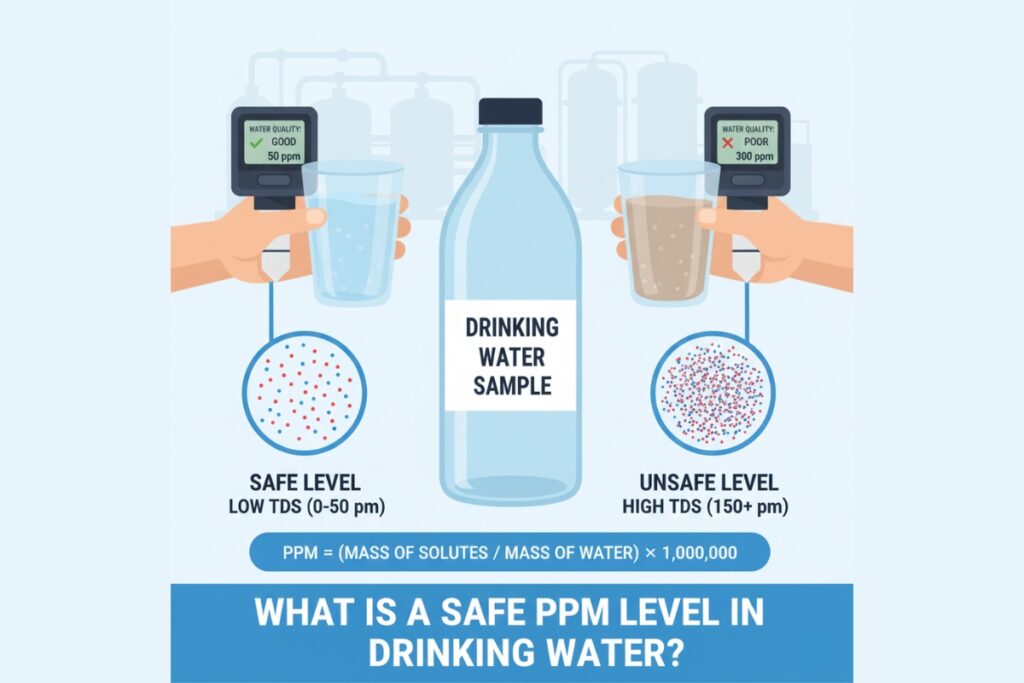
5. Bottled Water and Drinking Water
Contaminants monitored at ppm or lower.
Example:
Nitrate limit = 10 ppm
Lead limit = 0.015 ppm
Water quality relies on accurate concentration measurement.
Calculation Walkthrough: Preservative in Lotion
Scenario
A lotion batch weighs 200 kg.
Preservative target = 800 ppm.
Step 1: Apply formula
Required mass = 800 × 200 / 1,000,000
= 0.16 kg
Step 2: Convert to grams
0.16 kg = 160 g
The manufacturer must add 160 grams of preservative.
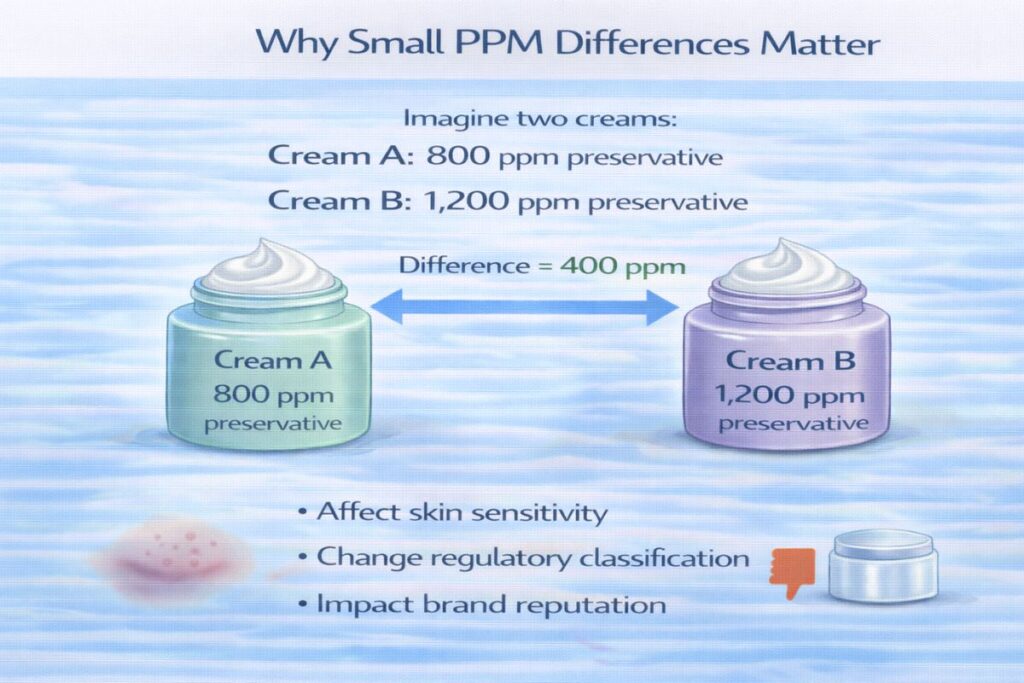
Industry Case Study 1: Cosmetic Recall Due to Excess Preservative
A skincare brand used incorrect ppm calculation.
Target = 1,000 ppm
Actual concentration = 1,850 ppm
Result:
- Consumer irritation complaints
- Product recall
- Financial loss exceeding ₹4 crore
Cause: Unit conversion error.
Industry Case Study 2: Baby Shampoo Reformulation
A baby shampoo manufacturer reduced preservative from 900 ppm to 600 ppm after safety review.
Outcome:
- Lower irritation rates
- Maintained microbial stability
- Increased consumer trust
PPM optimization improved market acceptance.
Comparison Table: Typical PPM Ranges in Consumer Goods
| Product | Ingredient | Typical PPM Range |
|---|---|---|
| Shampoo | Preservatives | 500–1,000 |
| Toothpaste | Fluoride | 1,000–1,500 |
| Lipstick | Trace metals | <10 |
| Packaged drinks | Preservatives | 100–300 |
| Drinking water | Nitrate | <10 |
How Regulators Set Safe PPM Limits
Agencies conduct:
1️⃣ Toxicology studies
2️⃣ Exposure modeling
3️⃣ Safety factor application
4️⃣ ppm conversion
5️⃣ Legal limit enforcement
For daily-use products, limits are conservative.
Why Trace Chemicals in Cosmetics Are Measured in PPM
Cosmetic formulations involve:
- Stability testing
- Skin compatibility studies
- Heavy metal screening
- Microbial challenge tests
All rely on ppm-level precision.
PPM vs Percentage in Consumer Goods
| Unit | Suitable For | Example |
|---|---|---|
| Percentage | Major ingredients | Water = 70% |
| PPM | Trace ingredients | Preservative = 800 ppm |
PPM provides high-resolution control.
Common Misconceptions About PPM in Everyday Products
1. “PPM Means Dangerous”
Not necessarily. Many safe ingredients exist at ppm levels.
2. “Higher PPM Means Better Performance”
Incorrect—optimal range matters.
3. “All ppm Are Equal”
Different ingredients have different toxicity thresholds.
4. “PPM Equals mg/L Always”
Only true in water with density ≈1 kg/L.
How Manufacturers Ensure Accurate PPM Control
✔ Analytical testing (HPLC, GC-MS)
✔ Batch documentation
✔ Automated dosing systems
✔ Quality audits
✔ Digital calculation tools
Precision prevents recalls.
Tools & Calculators in the Digital Era
Manual ppm calculation was once done using slide rules.
Today, digital tools simplify the process.
Trusted Platform: ppmcalculation.com
ppmcalculation.com offers:
Advantages
- Accurate ppm formula implementation
- Instant calculation
- Mobile-friendly design
- No registration
- Suitable for students and professionals
The evolution of ppm now includes digital precision.
Frequently Asked Questions (FAQs)
1. Are ppm levels safe in cosmetics?
Yes, when within regulatory limits.
2. Why are heavy metals allowed in ppm levels?
Trace impurities are unavoidable but tightly regulated.
3. Can ppm affect skin sensitivity?
Yes, especially preservatives and fragrances.
4. How are ppm levels tested?
Using advanced laboratory instruments like ICP-MS and HPLC.
5. Is ppm the same across all products?
No. Acceptable limits vary by ingredient and application.
6. Why use ppm instead of percentage?
Because trace ingredients require precise measurement.
Why How PPM Impacts Everyday Products Matters
Understanding how ppm impacts everyday products reveals the invisible science behind safety, quality, and regulatory compliance.
Key Takeaways
✔ PPM controls trace ingredient levels
✔ Even small changes affect safety
✔ Accurate ppm calculation prevents recalls
✔ Regulators enforce strict ppm limits
✔ Digital tools enhance reliability
From shampoo to toothpaste, ppm ensures that everyday products remain safe, stable, and effective.
👉 Visit ppmcalculation.com today to access:
Related PPM Calculators
Explore more water quality and chemistry tools: