Why Understanding PPM Calculation Matters
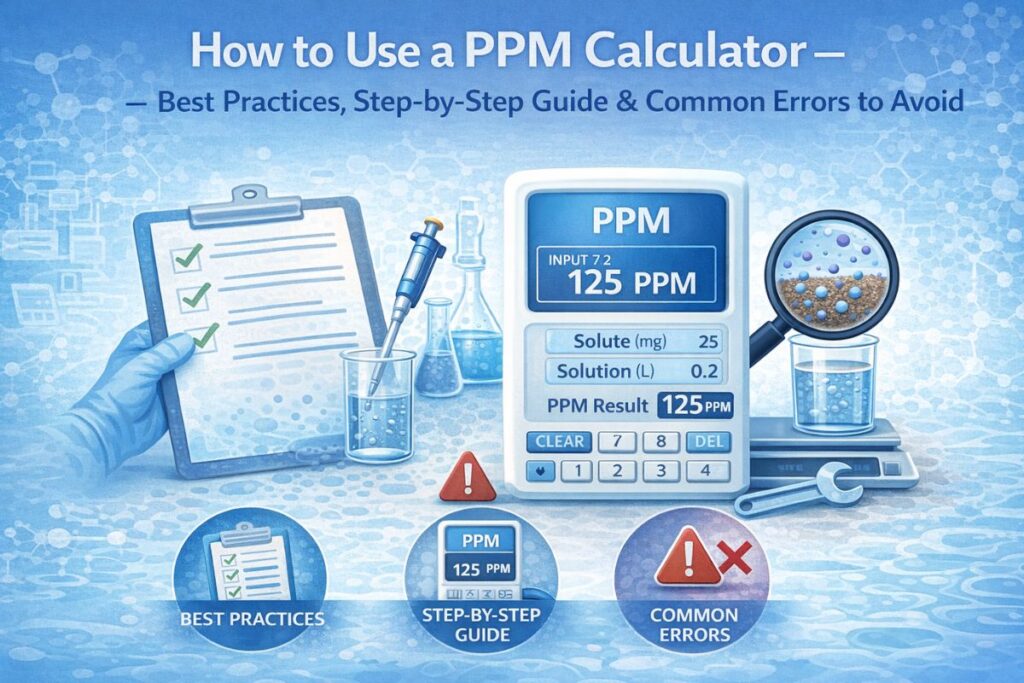
If you’ve ever tested water quality, measured air pollution, or worked with chemical solutions, you’ve likely encountered parts per million (ppm). But a common question remains: how do you calculate ppm accurately?
PPM is a fundamental concentration measurement used across industries—from environmental monitoring and pharmaceuticals to food processing and manufacturing. Miscalculating ppm can lead to unsafe conditions, regulatory violations, or poor product quality.
This guide provides a clear, scientifically accurate, and practical explanation of ppm calculation, suitable for both technical professionals and beginners.
What Is PPM (Parts Per Million)?
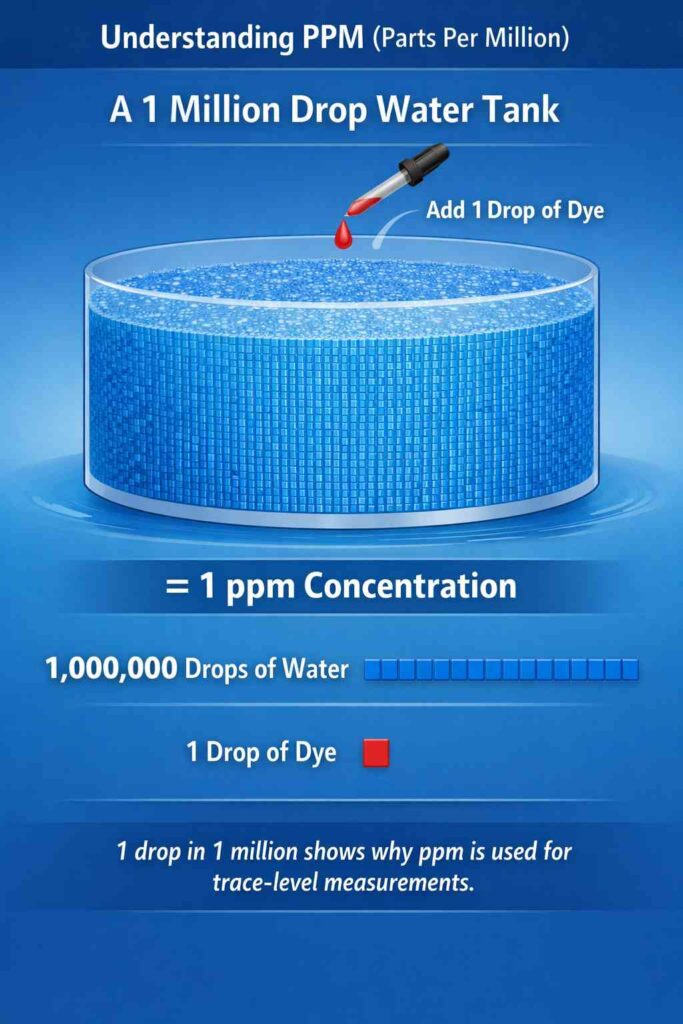
PPM (parts per million) represents the ratio of one substance to one million parts of another.
Basic Definition:
- 1 ppm = 1 part of solute per 1,000,000 parts of solution
Simplified Interpretation:
- 1 ppm = 1 mg per liter (mg/L) (for water-based solutions)
This equivalence is widely used in water quality testing, where density is close to 1 g/mL.
How Do You Calculate PPM? (Core Formula)
General PPM Formula:
PPM=(Mass of solutionMass of solute)×106
Alternative Common Formulas:
| Scenario | Formula |
|---|---|
| Solid in liquid | ppm = (mg solute / L solution) |
| Gas concentration | ppm = (volume of gas / volume of air) × 10⁶ |
| Percentage to ppm | ppm = % × 10,000 |
Step-by-Step PPM Calculation (Worked Example)
Example 1: Water Solution
You dissolve 5 mg of salt in 1 liter of water.
Step 1: Identify values
- Solute = 5 mg
- Solution = 1 L
Step 2: Apply formulaPPM=15=5 ppm
✅ Final Answer: 5 ppm
Example 2: Percentage to PPM
Convert 0.02% concentration into ppm.PPM=0.02×10,000=200 ppm
✅ Final Answer: 200 ppm
Example 3: Mass-Based Calculation
You have 0.003 g of chemical in 2 kg solution.
Convert units:
- 0.003 g = 3 mg
- 2 kg = 2,000,000 mg
PPM=(2,000,0003)×106=1.5 ppm
✅ Final Answer: 1.5 ppm
PPM to mg/L Conversion (Most Common Use Case)
For water and dilute solutions:
| PPM | mg/L |
|---|---|
| 1 ppm | 1 mg/L |
| 10 ppm | 10 mg/L |
| 100 ppm | 100 mg/L |
| 1000 ppm | 1000 mg/L |
👉 This equivalence works because:
- Density of water ≈ 1 g/mL
Industry Applications of PPM Calculation
1. Water Treatment
- Chlorine levels: 1–3 ppm (safe drinking range)
- Fluoride: ~0.7 ppm
2. Air Pollution Monitoring
- CO₂ levels: ~400 ppm (ambient air)
- CO exposure limits: < 50 ppm (OSHA)
3. Food Industry
- Additives and preservatives measured in ppm
4. Pharmaceuticals
- Drug impurities controlled in ppm levels
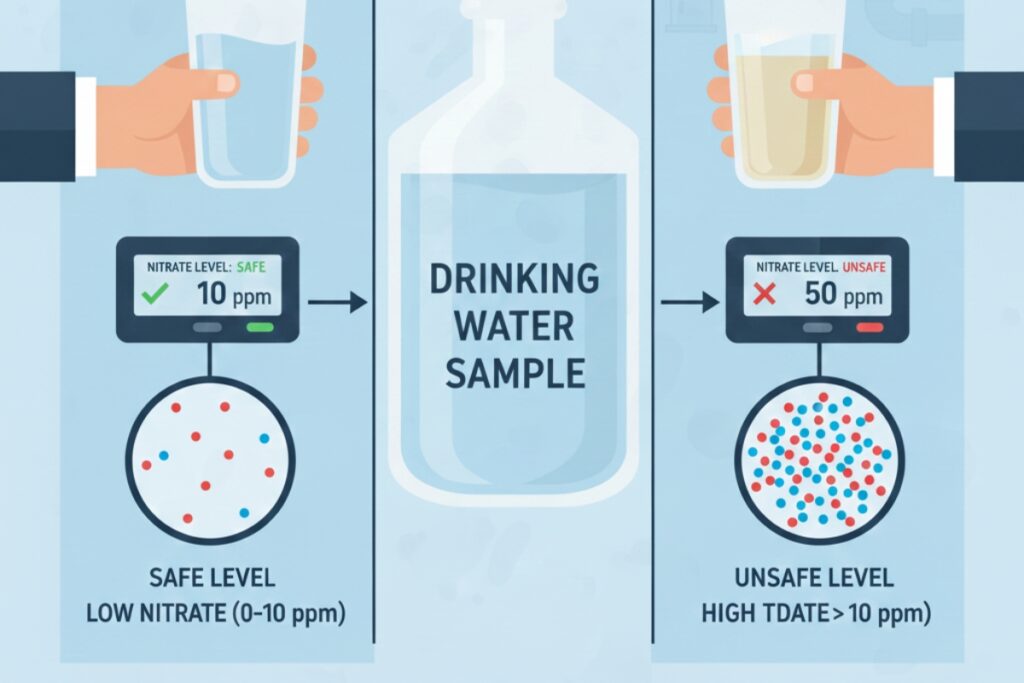
Case Study: PPM in Drinking Water Safety
A municipal water plant detected chlorine concentration at 4 ppm.
Analysis:
- Recommended range: 1–3 ppm
- Result: Slightly above safe limit
Action Taken:
- Adjusted dosing system
- Re-tested to achieve 2 ppm
📌 Outcome: Safe drinking water restored
This demonstrates how accurate ppm calculation directly impacts public health.
PPM vs Other Concentration Units
| Unit | Meaning | Conversion to PPM |
|---|---|---|
| % (percent) | per 100 | ×10,000 |
| ppb | parts per billion | ÷1000 |
| mg/L | milligrams per liter | ≈ ppm |
| molarity | mol/L | depends on molar mass |
Tools & Calculators for PPM
Manual calculation can be error-prone, especially with unit conversions.
Recommended Solution:
Use online tools like ppmcalculation.com
Why Use a PPM Calculator?
- Instant results
- Unit conversion support
- Reduces human error
- Suitable for professionals and students
Key Features to Look For:
- ppm to mg/L converter
- percentage to ppm conversion
- multi-unit input support
- mobile-friendly interface
Common Mistakes in PPM Calculation
❌ 1. Ignoring Unit Consistency
Always convert units (g → mg, kg → mg)
❌ 2. Confusing ppm with %
- 1% ≠ 1 ppm
- 1% = 10,000 ppm
❌ 3. Using Volume Instead of Mass Incorrectly
Mass-based formulas are more accurate unless density is known
❌ 4. Assuming ppm Always Equals mg/L
Only valid for water-like densities
Advanced Insight: When PPM Becomes Critical
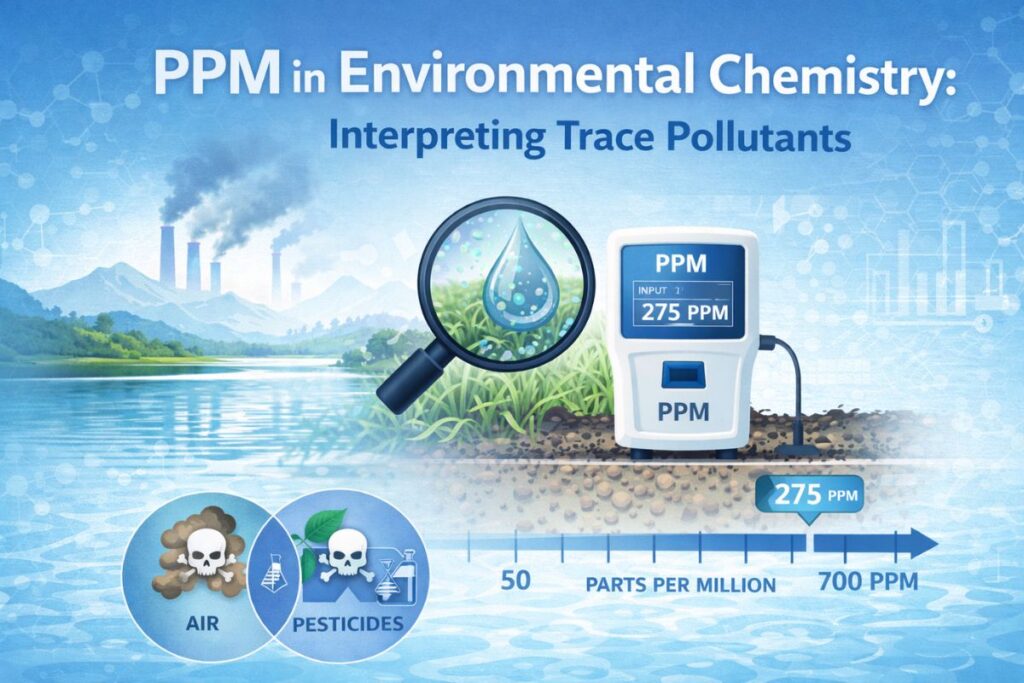
In chemical engineering and environmental science, ppm is used for:
- Trace contaminants
- Toxicity thresholds
- Process control
Even a 1 ppm deviation can:
- Affect reaction yield
- Cause regulatory non-compliance
- Impact human health
FAQs: How Do You Calculate PPM?
1. What is the easiest way to calculate ppm?
Use:
ppm = (mg/L) for water-based solutions
2. How do you calculate ppm from percentage?
Multiply percentage by 10,000
3. Is ppm always equal to mg/L?
Only when density ≈ water (1 g/mL)
4. How do you calculate ppm in air?
Use volume ratio:
ppm = (volume of gas / total air volume) × 10⁶
5. Can I calculate ppm online?
Yes, platforms like ppmcalculation.com provide accurate tools for instant results.
Summary
- PPM (parts per million) is a critical unit for measuring low concentrations
- Use the formula:
→ (mass of solute / mass of solution) × 10⁶ - For water:
→ ppm = mg/L - Always ensure unit consistency
- Use tools like ppmcalculation.com for accurate and fast calculations
Related PPM Calculators
Explore more water quality and chemistry tools: