
PPM, or parts per million, is a scientific unit used to describe extremely low concentrations of substances in air, water, soil and chemical solutions. It expresses how many parts of a substance are present in one million parts of the total mixture. Because many pollutants and dissolved chemicals appear in tiny quantities, PPM provides a clear and standardized way to measure them with precision.
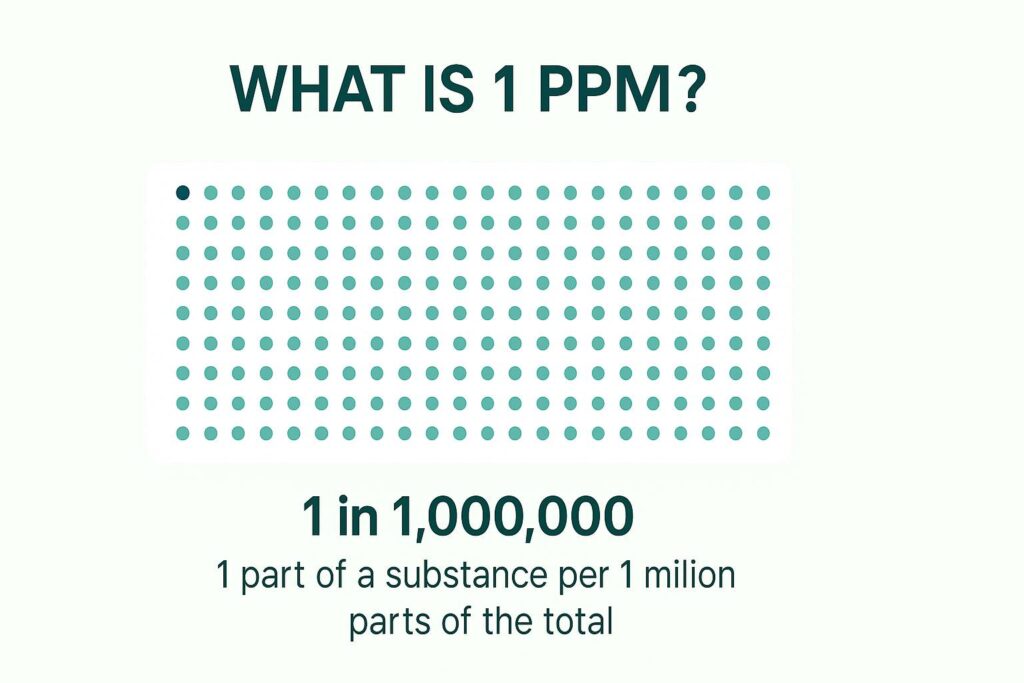
PPM is preferred in environmental science, chemistry and industry because it expresses trace amounts in a simple ratio rather than in complex decimals. Instead of writing a concentration as 0.0001 percent, scientists can express it as 1 PPM, which is easier to understand and compare.
Understanding One Part Per Million
One part per million means a single unit of substance mixed into one million equal parts of the total material. This is a very small ratio. For example, one milligram of a substance dissolved in a litre of water is approximately one PPM because a litre of water weighs one million milligrams. In the same way, one PPM of gas in air represents one molecule of that gas among one million air molecules.
This perspective reveals how tiny a PPM is, yet such trace amounts are often scientifically significant. Pollutants, minerals, metals and gases can have noticeable biological and chemical effects even at one or two PPM.
PPM in Water
When measuring solutes in water, PPM is closely associated with the unit milligrams per litre. One PPM is equal to one milligram of solute in one litre of water because the density of water makes the conversion direct. This simple relationship allows water chemists to measure chlorine, fluoride, nitrate, dissolved oxygen and mineral concentrations accurately.
For example, if a swimming pool contains three milligrams of chlorine in each litre of water, that concentration is three PPM. Similarly, if filtered drinking water contains one milligram of calcium carbonate per litre, the hardness level is one PPM. These values help determine purity, safety and quality.
PPM in Air and Gas Concentrations
In gases, PPM describes the proportion of gas molecules in relation to the surrounding air. Because gases expand and contract with temperature and pressure, their concentration cannot be understood by mass alone. Instead, gas concentration in PPM is based on molecular ratios.
To convert between mass concentration and PPM in gases, scientists use the ideal gas law, represented by the equation PV equals nRT. This law explains that gas volume changes with temperature and pressure, and the number of molecules per unit volume is not constant. As a result, the same mass of a gas may produce different PPM values under different environmental conditions.
A real example is ozone. Fifty micrograms per cubic metre of ozone at twenty five degrees Celsius corresponds to a particular PPM value. If the temperature rises, the same mass of ozone occupies a larger volume of air, lowering the calculated PPM. This is why accurate gas conversions must include temperature, pressure and molecular weight.
Scientific Formula for Gas Phase PPM
The formula used to calculate PPM from mass concentration in air is based on the ideal gas law. The expression is PPM equals mass concentration multiplied by the gas constant and temperature, divided by the product of molecular weight, pressure and one thousand. This formula produces a concentration value that reflects real atmospheric conditions.
This scientific approach ensures that air quality measurements remain accurate even when conditions vary. It is essential for calculating PPM values for pollutants such as nitrogen dioxide, sulphur dioxide, carbon monoxide and volatile organic compounds.
Real Examples of PPM in Daily Use
If indoor air contains eight hundred PPM of carbon dioxide, that means eight hundred molecules of CO₂ exist among every one million molecules of air. This value indicates how well a room is ventilated. Concentrations above one thousand PPM often suggest inadequate airflow.
Chlorine in water is another common example. A reading of four PPM chlorine in a pool indicates four milligrams of chlorine per litre of water. This concentration is necessary for disinfection, yet concentrations that are too high may cause irritation.
Another example occurs in atmospheric monitoring. If nitrogen dioxide is measured at fifty micrograms per cubic metre, the corresponding PPM value depends on temperature and pressure. This conversion allows environmental agencies to compare measurements across different regions and climates.
Why PPM Is Scientifically Important
PPM is vital in fields where small concentrations matter. Even a few PPM of certain chemicals can influence environmental quality, human health or chemical reactions. It is used to evaluate pollutants, test water treatment processes, calibrate laboratory instruments and monitor industrial emissions.
In environmental science, PPM helps track gases that contribute to smog or climate change. In chemistry, it quantifies impurities and dissolved elements. In industry, it ensures that materials meet quality standards by detecting contaminants at levels too low to measure with conventional units.
PPM Compared with Other Units
PPM is part of a larger family of concentration units. One PPM is equal to zero point zero zero zero one percent. In atmospheric science, PPM is one thousand times larger than parts per billion. In dilute water solutions, PPM is the same as milligrams per litre. These relationships allow easy conversion between units depending on the required precision.
Summary
PPM is a fundamental scientific unit that measures extremely small concentrations in air, water and other materials. It represents one part of a substance per one million parts of a mixture, making it ideal for monitoring pollutants, dissolved chemicals and trace contaminants. Through the combination of molecular principles and the ideal gas law, PPM provides a clear and reliable method for describing concentrations across many scientific and industrial fields.
FAQ – What Is PPM?
What does PPM mean in scientific terms
PPM means parts per million, a unit used to measure extremely small concentrations of substances. It represents how many parts of a chemical, gas or particle exist within one million parts of the total mixture. Because many contaminants and dissolved substances occur in tiny quantities, PPM allows those low levels to be described with precision without using complicated decimals.
Why is PPM used instead of percentages
Percentages are based on one hundred parts, which becomes impractical when describing trace amounts. A value like zero point zero zero zero one percent is difficult to read and compare. Expressing the same concentration as one PPM makes the number simpler, more meaningful and easier to interpret in environmental science, chemistry and gas analysis.
How small is one PPM
One PPM is an extremely small concentration. It is equal to one milligram of a substance in one litre of water or one molecule of a contaminant among one million molecules of air. Even though the quantity is tiny, many substances such as ozone, carbon monoxide, lead, fluoride and chlorine can have measurable effects at only a few PPM.
What is the relationship between PPM and mg per litre
In water chemistry, one PPM is equal to one milligram per litre. This is because one litre of water has a mass of one million milligrams, creating a direct one-to-one relationship. This makes PPM a convenient unit for measuring dissolved minerals, disinfectants and impurities in water samples.
How is PPM used for gases
For gases, PPM expresses the ratio of gas molecules compared to the total number of air molecules. Gas concentration depends on temperature and pressure, so PPM values for gases often require the ideal gas law for accurate conversion. This ensures that the PPM measurement reflects real environmental conditions and not just a fixed standard value.
Why do temperature and pressure affect PPM in gases
Temperature and pressure change the density of air. When air warms, it expands and the same mass of a gas occupies a larger volume, reducing its PPM. When pressure increases, air becomes denser and the same amount of gas occupies a smaller volume, increasing its PPM. This is why scientific gas calculations always include temperature and pressure corrections.
Is PPM the same for all substances
PPM represents the same ratio for all substances, but the actual number of molecules and the physical effect of those molecules vary with molecular weight and chemical properties. Heavier gases produce lower PPM values for the same mass concentration, while lighter gases produce higher PPM values. Therefore, PPM must always be interpreted in context with the substance being measured.
Where is PPM commonly used
PPM is used in water treatment, environmental monitoring, atmospheric science, food chemistry, industrial quality control, laboratory analysis and safety testing. It helps measure contaminants, gases, dissolved solids, minerals, disinfectants and impurities with accuracy. Because many harmful or beneficial substances act at very low concentrations, PPM is essential for scientific and regulatory measurements.
Why is PPM important in environmental science
Environmental pollution often appears at extremely small concentrations. PPM allows scientists and regulators to quantify these concentrations with enough precision to track trends, set safety standards and evaluate risks. Whether measuring ozone in air or nitrates in water, PPM provides a clear and consistent way to express pollutant levels across different environments.
How does PPM compare to PPB and percentage
PPM is one thousand times larger than parts per billion and one PPM is equal to zero point zero zero zero one percent. These relationships make it possible to convert between units depending on the level of detail required. PPM serves as the middle ground between the larger percentage scale and the much smaller PPB scale.